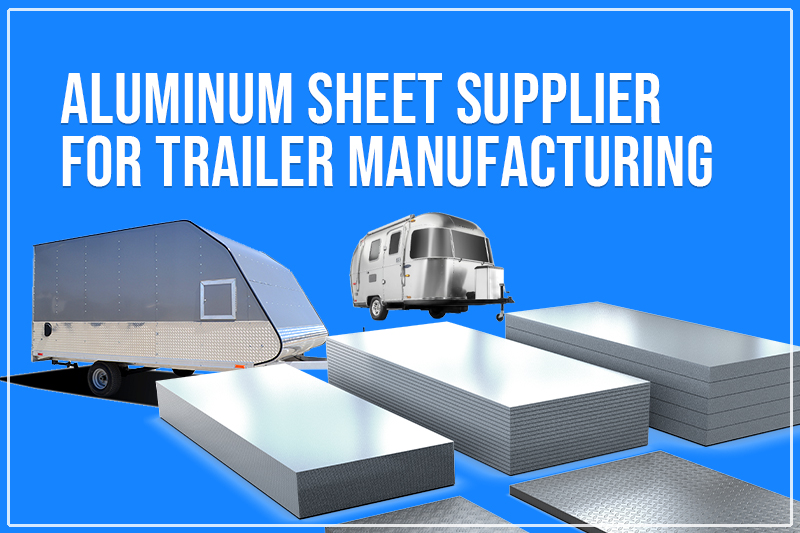
Aluminum sheet selection for trailer manufacturing involves more than comparing prices. Choosing the right aluminum sheet supplier for trailer manufacturing means finding a partner who can consistently deliver suitable alloys, correct specifications, and stable batch quality. The following guide covers alloy selection, thickness and width matching, supplier evaluation, and the hidden costs that affect long-term production.
Aluminum sheet is widely used for trailer side walls, roofs, floors, and structural connectors because it helps reduce body weight, increase payload, and resist corrosion through a natural oxide layer. These benefits matter most when the material is supplied consistently and matches the intended application.
– Weight reduction supports better fuel efficiency and higher load capacity.
– Corrosion resistance reduces maintenance in wet, coastal, and chemical-exposure environments.
– Formability and weldability affect how easily the sheet can be cut, bent, and assembled.
Alloy choice should follow the application, not the other way around. A sheet that works well for a side wall may not be the best choice for a floor or a structural bracket.
– Side walls and roofs: 3003-H14 is economical and easy to form; 5052-H32 offers better dent resistance and corrosion resistance for frequent loading or high-wear conditions.
– Floors and load-bearing panels: 5083-H116 or H321 provides higher strength and corrosion resistance for heavy loads, wet environments, and chemical contact.
– Structural connectors: 6061-T6 is often used where higher strength is required, such as brackets or load-bearing components.
Temper also matters. H14, H32, and H116 are not interchangeable in every fabrication process. Bending, welding, and stress corrosion resistance can all be affected by the chosen temper, so it should be matched to how the sheet will be processed.
Different trailer components call for different sheet dimensions. Side walls typically use thinner sheets, roofs need to handle snow loads and occasional foot traffic, and floors require greater thickness and strength. Wider sheets can reduce seams, which improves assembly efficiency and sealing.
|
Consideration |
What It Affects |
|
Thickness |
Load capacity, weight, and rigidity |
|
Width |
Number of seams, assembly time, and sealing |
|
Tolerance |
Fit and assembly precision |
|
Flatness |
Surface contact and panel alignment |
|
Surface quality |
Painting, appearance, and final finish |
Once specifications are set, the next question is whether the supplier can maintain stable long-term supply rather than sourcing on an ad-hoc basis.
1. Certification and traceability: Request mill test certificates for each batch, compliant with ASTM B209 or EN 573, and ISO 9001 certification.
2. Production capability and lead time: In-house hot or cold rolling lines usually support better batch consistency and lead time control. Clarify standard lead time and peak-season capacity.
3. Batch consistency: Alloy composition, mechanical properties, and surface condition should remain stable within the same batch to avoid color differences or performance fluctuations.
4. Technical selection support: Can the supplier recommend alloys and tempers based on your application, rather than just providing a quote?
5. Samples and after-sales: Are samples available for validation, and is the quality dispute process clear?
6. Quote transparency: Specify alloy, temper, thickness, width, tolerance, surface requirements, MOQ, and mixed-container support.
A supplier who communicates clearly before the order is usually easier to work with after the order as well.
Aluminum sheet pricing typically consists of the aluminum ingot base price plus a processing fee. The processing fee varies by alloy, temper, thickness tolerance, and order volume. However, unstable lead times, batch variations, and rework losses often outweigh the price difference per ton. Including lead time, quality stability, and technical support in the total cost evaluation leads to more reliable long-term production.
Surface treatment and further processing of aluminum coils are usually handled downstream. It is therefore important to clarify whether the supplier’s scope covers only raw aluminum sheet, so that process integration does not become an unexpected issue later.
If you are looking for an aluminum sheet supplier for trailer manufacturing, Henan Mingtai Aluminum offers 3003, 5052, and 5083 alloy sheets for side walls, roofs, and floors, and can discuss specifications and lead times with you.
Q: What aluminum alloy is commonly used for trailer side walls?
A: 3003-H14 and 5052-H32 are common choices, balancing formability, corrosion resistance, and cost.
Q: What aluminum sheet is suitable for trailer floors?
A: 5083-H116 or H321 is preferred for its strength and corrosion resistance in load-bearing and wet environments.
Q: How can I judge if an aluminum sheet supplier is reliable?
A: Check mill test certificates, batch consistency, lead-time commitments, and technical selection support.
Q: Do aluminum sheets need surface treatment?
A: Standard trailer aluminum sheets are supplied with a mill finish; surface treatment or further processing is typically done downstream.
Q: How can I verify batch quality?
A: Request same-batch samples and mechanical property reports, and conduct bend or weld trial validation.