In CNC machining and mold-making workshops, a common headache keeps coming back: you carefully machine a fixture or tooling plate, mount it on the machine, and find it warped or uneven. Precision goes out the window.
This is rarely an operator error — it’s often the wrong material choice. Aluminum tooling plate is specifically designed to solve this problem.
A tooling plate is a high-precision aluminum plate that comes from the mill stress-relieved and double-side precision-milled. What makes it different from ordinary aluminum plates?
– Low internal stress – Remove material and the plate stays flat. No warping as you machine deeper.
– High flatness – Most grades achieve ±0.005″/ft flatness, ready to use out of the box.
– Light weight – Only one‑third the weight of a steel plate of the same size. Easier to handle and change fixtures.
In short: ordinary aluminum is for making parts. A tooling plate is for making tooling.
This is the most common question when buying. The key difference lies in internal stress caused by the manufacturing process.
– Extremely low internal stress, excellent dimensional stability
– Almost no warping after machining – ideal for precision fixtures and mold bases
– High factory flatness – no secondary surfacing needed
– Good strength and toughness, but higher residual stress
– Prone to warping after large‑area or deep milling
– Better for structural parts and general machined components – not ideal for precision tooling
> One‑line takeaway: For accuracy and reliability, choose cast tooling plate. For ordinary structural parts, rolled plate is fine.
Many customers ask: “Can I just use 6061 plate for my fixtures?”
The answer: For a quick fix, maybe. For regular use, no.
6061 plate is the all‑rounder among rolled products – good weldability, good strength, great for parts. But when you use it for large fixtures, especially with deep cavities or many drilled holes, the release of internal stress almost always causes warping.
A tooling plate (whether cast or specially processed rolled plate) prioritizes flatness after machining. Think of it this way:
– 6061 plate → good material for making parts
– Tooling plate → good material for making tooling
If your shop frequently makes fixtures with ±0.1mm tolerance requirements, switch to a dedicated tooling plate and save yourself the hassle of re‑flattening.
Different alloys suit different needs. Here’s what customers ask most often:
– 5083 – Outstanding corrosion resistance and good weldability. Best for welding fixtures, marine tooling, food machinery bases.
– 6061 – Best all‑around balance, very easy to machine. The go‑to choice for general tooling – CNC fixtures, mold bases, gauge plates.
– 7075 – Highest strength and rigidity. Ideal for heavy‑duty fixtures, aerospace tooling, demanding load applications. Lower weldability, but excellent surface finish.
> Not sure where to start? Go with 6061. Switch to 5083 or 7075 only for special requirements.
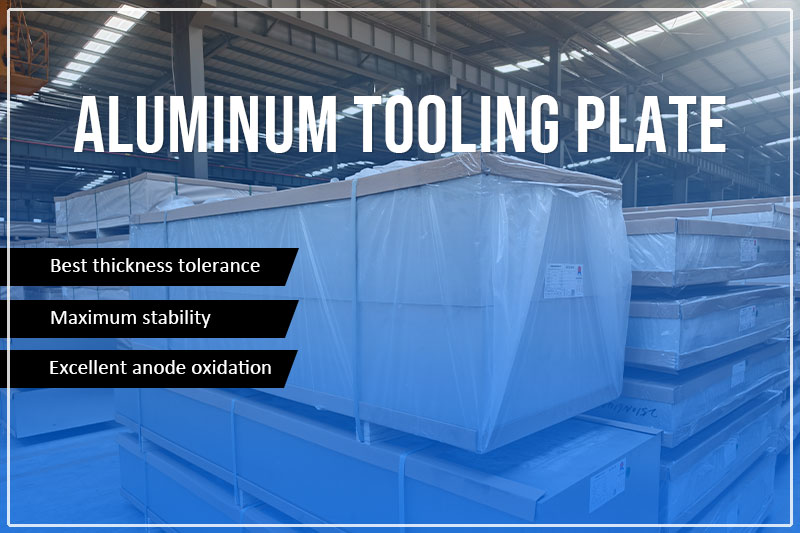
When purchasing an aluminum tooling plate, two numbers matter most:
– Thickness range – From 5mm up to over 160mm. Cast plates can reach 150mm+; thicker plates can also be supplied as tooling blocks.
– Flatness – High‑quality cast plates achieve ±0.005″/ft. Premium grades reach ±0.002″/ft. Thicker plates generally offer better flatness.
Also, the factory surface roughness is typically 32 microinches or better – ready for machining without extra preparation.
Tooling plates are used across many manufacturing areas:
– CNC worktables and fixture bases
– Welding fixtures and assembly tooling
– Inspection gauges and measurement bases (highest flatness requirements)
– Mold bases or cavity plates for injection molds
– Rubber molds and thermoforming molds
Simply put: whenever you need a flat, stable aluminum plate that won’t warp under machining, a tooling plate is the right answer.
A high‑quality tooling plate directly improves your fixturing efficiency and machining yield. Mingtai Aluminum supplies tooling plates in multiple alloys and thicknesses. Contact us for detailed technical data and pricing.
Q: Can I mount a tooling plate directly on a CNC machine for machining?
A: Yes – it comes factory‑milled, so you can program and cut immediately.
Q: Is cast tooling plate more durable than rolled plate?
A: Durability is similar, but cast plate stays flat after machining – so its precision lasts longer.
Q: Does tooling plate need surface treatment?
A: Usually not. Aluminum has natural corrosion resistance; use it as is.
Q: Which is more expensive – 5083 or 6061 tooling plate?
A: 5083 is slightly more expensive, but the difference is small. Choose based on your application.
Q: Can tooling plate replace steel for molds?
A: Yes for low‑to‑medium volume and weight‑sensitive molds. For high‑volume production, steel is still better.