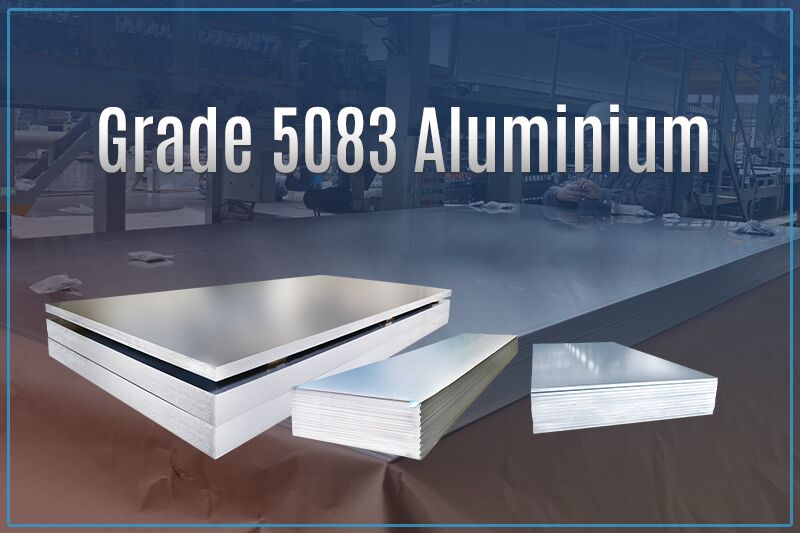
Grade 5083 aluminium belongs to the 5xxx series aluminium-magnesium alloys. It is the highest strength non-heat-treatable alloy in this series.
Its main alloying elements are magnesium (4.0%-4.9%) and manganese, with a small amount of chromium added. These elements work together to give 5083 its unique combination of properties. It is highly regarded in marine engineering, transport equipment, and cryogenic vessels.
1 Unmatched Corrosion Resistance
This is the most outstanding feature of 5083. It has excellent resistance to seawater and industrial chemical environments. It passes standard tests like ASTM G66 and G67, showing strong resistance to intergranular corrosion and exfoliation corrosion. Simply put, it maintains structural integrity even in harsh marine environments.
2 Excellent Strength and Mechanical Properties
It is the strongest alloy in the 5xxx series. More importantly, the strength in the weld area remains stable after welding. This is critical for large structural components. Whether it’s a ship hull or a storage tank, the welded joints do not become weak points.
3 Good Formability and Weldability
5083 has excellent performance with TIG and MIG welding. 5356 or 5183 filler wires are commonly recommended. It does not become brittle at low temperatures; in fact, its toughness improves. This is why it is widely used in low-temperature equipment like LNG storage tanks.
Shipbuilding and Marine Engineering
This is the most classic application for 5083. It is widely used for:
– Ship hulls and decks
– Speedboats and deep-sea fishing vessels
– Offshore drilling platforms
When purchasing, pay attention to classification society certification requirements, such as LR, ABS, or BV. These certifications are basic guarantees of material compliance.
Special Vehicles and Transport
Dump truck bodies, tanker trucks, and railway freight cars all use large amounts of 5083. Its combination of high strength and light weight helps users increase payload and reduce transportation costs.
Pressure Vessels and Low-Temperature Equipment
Liquefied Natural Gas (LNG) storage tanks and cryogenic tank containers are important applications. This relies on its excellent toughness at low temperatures.
Other Industrial Fields
Mining equipment (ore carts, buckets), bridge structures, and blast-proof panels also commonly use 5083.
Understanding Common Tempers
You will often see temper designations like H116, H321, and O.
– H116 and H321: These are special tempers designed for marine environments. They offer the best resistance to exfoliation corrosion combined with high strength. H321 achieves specified strength through strain hardening and stabilization, while H116 uses special processing controls. For most applications, they can be considered equivalent. The specific choice depends on your standard specifications.
– O Temper: This is the annealed condition. It offers the best formability and is suitable for parts requiring deep cold forming.
Size Specification Options
5083 aluminium plate is available in a wide range of thicknesses, from thin sheets to medium and heavy plates. Width and length can also be customized. When choosing a supplier, ask if they can meet your specific size requirements.
Comparison Reference
– Compared to 5052, 5083 has higher strength and better corrosion resistance.
– Compared to 6061, 5083 performs better in marine environments, while 6061 is more common for structural profiles.
For demanding applications requiring both high strength and high corrosion resistance, 5083 is almost irreplaceable.
Critical applications require suppliers to provide relevant certifications:
– Shipbuilding needs classification society certification (DNV, ABS, BV, LR, etc.)
– Pressure vessels require ASME standard certification
The Mill Test Certificate (MTC) is a basic document; always request it.
– Pay attention to thickness tolerances. Precision machining requires strict tolerances.
– Plate flatness is also important, as it affects cutting and splicing efficiency.
– Ask suppliers if their internal standards are stricter than national or ASTM standards.
Inspect the plate surface for defects like:
– Visible scratches
– Indentations
– Oil stains
– Oxidation discoloration
These defects can affect subsequent use. Surface quality is a key detail that is often overlooked.
5083 is often used in marine exports or humid environments. Packaging must be suitable for sea transport:
This ensures the material arrives in good condition.
Q1: Is Grade 5083 aluminium plate suitable for high-temperature environments?
A1: No. The recommended long term service temperature for 5083 should not exceed 65°C. Above this temperature, mechanical properties and corrosion resistance may decrease.
Q2: What filler wire should be used for welding 5083 aluminium plate?
A2: ER5356 is the most common choice. For higher weld strength and better color matching, ER5183 or ER5556 can be used. The choice depends on base metal thickness and design requirements.
Q3: What specifically makes Grade 5083 aluminium plate so corrosion resistant?
A3: It has excellent resistance to seawater and industrial atmospheres, particularly strong resistance to stress corrosion cracking and exfoliation corrosion. This makes it the recognized preferred material for marine environments.
Mingtai Aluminum is dedicated to providing you with stable performance and fully specified Grade 5083 aluminium plate, meeting various demanding requirements from marine engineering to special vehicles. Please contact us anytime for professional selection advice and quotations.