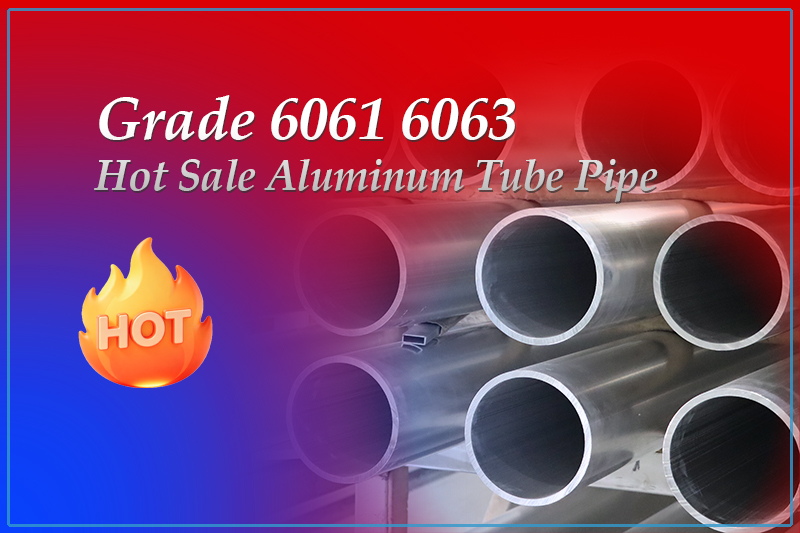
In the world of aluminum tubing, two alloys stand out as industry favorites: grade 6061 and 6063 hot sale aluminum tube pipe. They may look similar, but each serves a distinct purpose. Choosing the right one is crucial for your project’s success and cost-effectiveness.
The key difference between 6061 and 6063 lies in their composition.
6061 aluminum tube contains more magnesium and silicon. It undergoes a T6 heat treatment. This makes it a true “heavy-duty” alloy. It offers higher tensile strength and superior mechanical properties. Simply put, 6061 is stronger.
6063 aluminum tube focuses on “finish.” Its formula is optimized for extrusion. In the T5 temper, it achieves a smoother surface and better luster. 6063 is more aesthetic.
|
Property |
6061 Aluminum Tube |
6063 Aluminum Tube |
|
Strength |
High-Strength Structural Grade |
Medium-Strength Extrusion Grade |
|
Main Advantage |
Excellent Strength & Toughness |
Superior Surface Finish & Extrudability |
|
Common Temper |
T6 |
T5 |
|
Corrosion Resistance |
Good |
Excellent |
|
Weldability |
Excellent |
Good |
* Handling Heavy Loads: Machine frames, robotic structures.
* Dynamic Stress: Bicycle frames, truck chassis parts.
* Precision Machining: Complex, high-tolerance components.
* Welded Structures: Large welded frames, pressure vessels.
* Aerospace: Aircraft parts, structural components.
* Visual Appeal: Window/door frames, display cases, furniture.
* Complex Shapes: Decorative profiles with intricate cross-sections.
* Surface Treatment: Parts for anodizing or painting.
* Heat Dissipation: LED heat sinks, appliance cooling parts.
* Architectural Decor: Curtain walls, interior/exterior trim.
If your part withstands high stress, choose 6061. If it’s visible and needs a great finish, choose 6063.
Both are weldable. 6061 retains strength better after welding. For 6063, control parameters carefully to avoid distortion.
Typically, 6061 costs 5%-10% more than 6063. This is due to higher alloy content and heat treatment costs.
Check for material certification. Inspect the surface—it should be smooth and even. Verify dimensional tolerances. Test process a sample.
* T5 Temper: Cooled after extrusion and artificially aged. Ideal for 6063.
* T6 Temper: Solution heat-treated and artificially aged. Ideal for 6061.
* Anodizing: Improves corrosion resistance, allows coloring.
* Powder Coating: Durable, wide color range.
* Electroplating: Provides a uniform, adherent coating.
For projects demanding reliable performance, choosing the right grade 6061 6063 aluminum tube pipe is the first step. Partnering with a trustworthy supplier guarantees consistent quality and on-time delivery.
Choose expertise, choose peace of mind—let Mingtai Aluminum be your solid foundation.
Q: Can 6061 tube replace 6063?
A: For structural parts, yes, but at higher cost. For visual parts, no—6061’s surface finish is often inferior.
Q: How to tell them apart?
A: It’s hard visually. Check the material certificate or use a spectrometer.
Q: What are common wall thicknesses?
A: From 0.5mm thin-wall to 50mm+ thick-wall. Standard range is 1.0-10.0mm, based on pressure needs.
Q: Can I order custom alloys?
A: Yes. Adjusting the composition can achieve specific properties. This requires minimum order quantities and technical discussion.