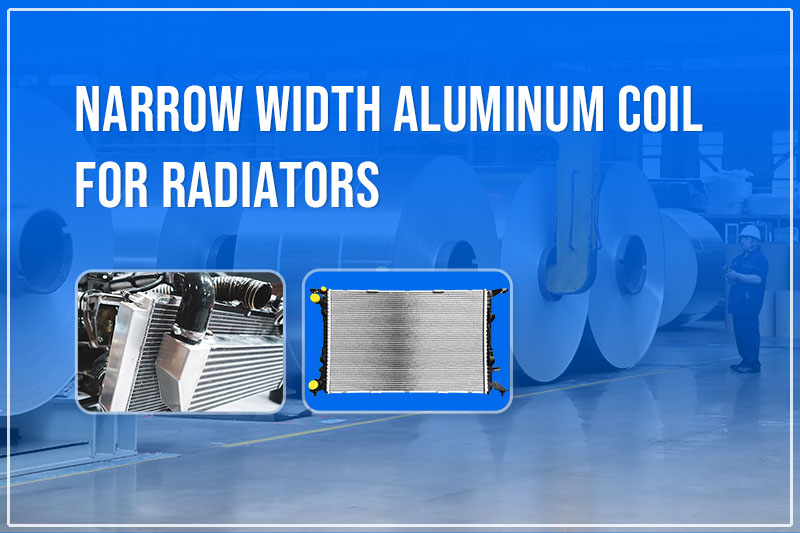
On a radiator production line – whether it’s high-frequency welded tubes for car radiators or corrugated fins for home heating units – you’ll find narrow width aluminum coil for radiators. This typically refers to aluminum coils between 30mm and 200mm wide, which can be used directly on the production line without additional slitting.
Many radiator manufacturers run into problems like off-center tube welds, fin jams in the die, or poor brazing results. These issues often come not from the equipment, but from unstable width, wrong alloy, or poor edge quality of the aluminum coil itself. Below we explain how to choose the right coil so your production line runs more smoothly.
– No need to buy and maintain slitting equipment – saves investment and labor
– Higher material utilization: width matches the die size directly, very little scrap
– Faster delivery: standard sizes allow the mill to stock more
But all these benefits depend on one thing – the narrow coil you buy must have accurate dimensions and consistent batch quality.
Mistake 1: Loose width tolerance leads to frequent welding stoppages
High-frequency tube welding is very sensitive to width. Suppose you need 120mm wide strip. If the actual width jumps between 119.5mm and 120.5mm, the overlap changes constantly – resulting in seam shifting and higher leakage.
Recommendation: Ask your supplier for a width tolerance of ≤ ±0.1mm. For precision small tubes, ask for ±0.05mm. Always put this in your purchase contract.
Mistake 2: Wrong alloy causes corrosion or blistering after brazing
The two most common alloys for radiators are 3003 and 1060.
– 3003 aluminum alloy: Good strength, corrosion resistant, no blistering after brazing – suitable for pressure-bearing tubes and headers.
– 1060 pure aluminum: Better thermal conductivity, softer – good for complex fin shapes, but too low strength for tubes.
A typical proven combination: use 3003 for tubes and 1060 for fins. Avoid cheap “off-cuts” or unknown alloy leftovers – they often have mixed chemistry and very unstable welding performance.
Mistake 3: Poor edge quality damages dies and weld heads
If the edge of a narrow aluminum coil has burrs, rolled edges, or tiny waves, it will scratch expensive weld heads and create aluminum dust. That dust can enter the cooling water circuit and clog fine water channels.
A question to ask your supplier: Are the edges trimmed? What is the residual oil level on the coil? (Note: we do not provide surface treatment, but you can still ask for the original cleanliness data.)
1. Spot-check width – Open a coil and measure the head and tail. The smaller the difference, the better the control.
2. Look at the edge – Under natural light, the edge should have no visible burrs or waves. Run your finger along it – it should not feel sharp.
3. Ask for batch reports – Are hardness and thickness consistent across different coils in the same order? Many rejects come from “same order, different performance.”
1. Dimensions: Width (including tolerance, e.g., ±0.1mm) × Thickness (including tolerance)
2. Material: Clear alloy and temper, e.g., 3003 H14 or 1060 H18
3. Mechanical properties: Tensile strength and elongation range – you don’t need the highest values, but batch-to-batch variation must be small
Remember: a coil that looks cheaper on price but increases your tube reject rate by 5% will cost you more in wasted material and downtime within weeks.
Picking the right narrow width aluminum coil for radiators is not complicated. Focus on three basics: width accuracy, correct alloy, and good edge quality. You don’t need to become an aluminum expert – just check the tolerance, ask about the alloy, and request batch reports. That will help you avoid most production problems.
Q1: What width is common for narrow aluminum coils used in automotive radiator high-frequency welded tubes?
A: Usually 30–80mm, depending on the tube outer diameter and overlap design.
Q2: Which is more corrosion resistant, 3003 or 1060?
A: 3003, because it contains manganese, performs much better when in long-term contact with water or coolant.
Q3: Why is width tolerance often more important than thickness tolerance?
A: Wrong width directly causes tube seam shift or fin die jamming, while thickness variation can often be compensated by adjusting gaps.
Q4: Can you slit the coil to my exact narrow width?
A: We do not perform secondary slitting, but we can directly produce original-edge narrow coils to your finished width.
Q5: How can I quickly check if a narrow aluminum coil has good brazing performance?
A: Ask the supplier for a “strength retention after simulated brazing” test report – the higher the retention, the better.
Mingtai Aluminum supplies narrow width aluminum coils for radiators with stable width tolerances, helping you reduce unplanned stops on your tube and fin lines. Please ask for brazing performance comparisons or our available width list.