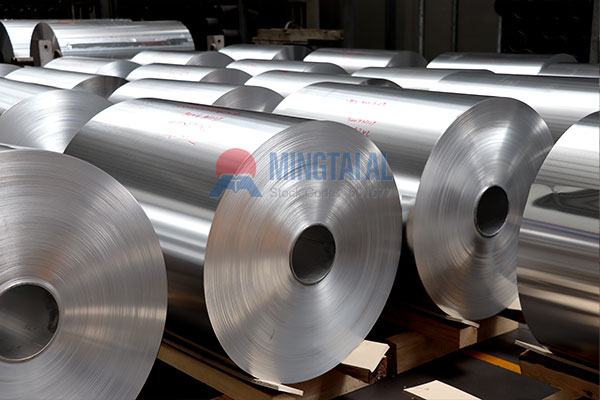
The winding material directly impacts transformer temperature rise, service life, and resistance to short‑circuit forces. In dry‑type and specialty transformers, 1235 O Temper Aluminum Foil has proven itself as a reliable, cost‑effective solution. This article covers its material characteristics, performance trade‑offs, critical specifications, and quality checks – all in one practical reference.
Alloy side – 1235 is a commercially pure aluminium grade with a minimum aluminium content of 99.35%. Total impurities (iron + silicon) stay below 0.65%, while other elements like copper, manganese, and zinc are each limited to 0.05% or less. This high purity delivers lower electrical resistivity and better corrosion resistance.
Temper side – “O” means fully annealed. After annealing, the foil reaches its softest, most ductile state – low yield strength and excellent elongation.
The combination is straightforward: 1235 ensures conductivity, while O‑temper ensures formability without cracking during winding.
Four main reasons stand out:
– Reliable conductivity – The material reaches about 62% IACS, which is sufficient for most medium‑ and low‑voltage windings, keeping resistive losses within acceptable limits.
– Winding‑friendly behaviour – Elongation typically exceeds 15%, allowing the foil to conform tightly to insulation layers without wrinkles or fractures. Foil‑wound structures have flat end faces and uniform inter‑turn capacitance, giving better short‑circuit strength than conventional wire windings.
– Good corrosion resistance – High‑purity aluminium naturally forms a dense oxide film, making it durable in humid or salty environments – ideal for coastal or underground installations.
– Wide thickness range – Transformer foil usually falls between 0.02 mm and 0.2 mm. We focus on supplying thicknesses above 20 microns, covering the vast majority of winding needs.
Many design engineers weigh aluminium against copper. Here is a quick look at the key differences:
|
Factor |
Aluminium Foil (1235‑O) |
Copper Wire |
|
Material cost |
Significantly lower |
Higher |
|
Density (g/cm³) |
~2.70 |
~8.89 |
|
Conductivity (%IACS) |
~61–62 |
~100 |
|
Cross‑section needed for same current |
~1.6× that of copper |
Baseline |
|
Weight advantage |
Greatly reduces overall transformer mass |
Heavier |
Bottom line – for medium‑ and low‑voltage dry‑type transformers, the foil offers outstanding overall benefits in cost, weight, and heat dissipation. Copper still holds an edge where space is extremely tight or loss targets are exceptionally strict. The right choice depends on project priorities.
When requesting quotes or placing an order, confirm these points:
– Thickness – typically 0.02–0.2 mm, chosen based on current density requirements. We only supply thicknesses above 20 microns.
– Width – commonly from 20 mm up to 1600 mm; can be customised to fit core dimensions and reduce edge trimming waste.
– Conductivity – should be at least 61% IACS; the mill test certificate (MTC) must state the actual measured value.
– Dimensional tolerance – thickness should be kept within ±3% to ensure uniform layer‑to‑layer consistency.
– Applicable standards – common references include ASTM B209, EN 485, and GB/T 3880. Always ask for the MTC.
Not all supplies are equal. Check the following four aspects:
– Chemical report – verify Al ≥ 99.35% and Fe+Si ≤ 0.65%. Excess impurities reduce conductivity.
– Mechanical test – confirm tensile strength and elongation are within reasonable ranges for O‑temper. Insufficient elongation leads to winding fractures.
– Surface condition – the foil should be flat, clean, free of oil stains, scratches, or oxidation spots – defects affect insulation adhesion.
– Edge quality – edges must be smooth and burr‑free. Burrs cause electric field concentration and increase partial discharge risk.
Uniform thickness across the entire coil is equally important – large variations cause uneven winding resistance and affect transformer balance.
1235‑O foil is mainly used in low‑voltage windings of dry‑type transformers, and also appears in some oil‑immersed designs. Transformers built with foil windings generally have smaller size, lighter weight, lower partial discharge, and quieter operation. They are widely deployed in high‑rise buildings, data centres, residential complexes, underground substations, and coastal areas.
Three practical suggestions for selection:
Henan Mingtai Al offers a stable supply of 1235 O Temper Aluminum Foil for transformer windings, with customisable thickness and width, and provides complete material test certificates for every shipment.
Q1: What does “O temper” mean in this foil?
A: It means fully annealed – the softest state, giving high ductility to prevent cracking during winding.
Q2: What is the minimum aluminium purity of the 1235 alloy?
A: At least 99.35%, which ensures good electrical conductivity and corrosion resistance.
Q3: Is aluminium foil a good substitute for copper in windings?
A: Yes – for most low‑voltage dry‑type transformers, it offers lower cost, lighter weight, and adequate conductivity.
Q4: What thickness range is typical for winding foil?
A: Usually 0.02 mm to 0.2 mm, depending on current‑carrying capacity and design.
Q5: Which standards apply to this foil?
A: Common ones are ASTM B209, BS EN 485, and GB/T 3880, covering composition, properties, and tolerances.