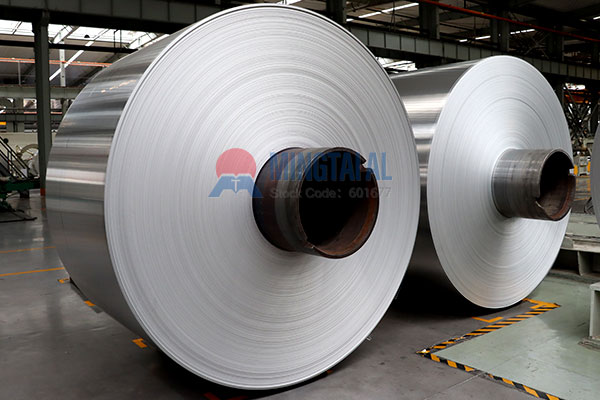
When selecting materials for electrical component manufacturing, performance metrics such as conductivity, thermal management, and long‑term reliability are top priorities. 1050 H18 Aluminum Coil for Electrical Components stands out because of its high purity, excellent electrical conductivity, and good mechanical strength. This article provides a practical reference for engineers and production managers, covering material characteristics, typical applications, and key sourcing considerations.
1050 aluminum belongs to the 1000‑series pure alloys, with an aluminum content of no less than 99.5%. High purity means fewer impurities—especially iron and silicon, which can reduce electrical performance.
The “H18” temper indicates a fully hardened state achieved through cold rolling (approximately 75% reduction). No annealing is applied afterward, resulting in maximum strength and hardness.
Key properties at a glance:
– Aluminum content: ≥ 99.5%
– Electrical conductivity: ~61% IACS (International Annealed Copper Standard)
– Tensile strength: ~140–160 MPa
– Yield strength: ~120–145 MPa
– Elongation: ~2%–7% (depending on thickness)
– Thermal conductivity: ~230 W/m·K
– Density: ~2.70–2.71 g/cm³
Several core advantages make this alloy a frequent choice in the electrical industry:
– Excellent conductivity. The high purity ensures stable electrical performance (~61% IACS). While copper offers higher conductivity (100% IACS), aluminum has only about one‑third the density. On an equal‑weight basis, aluminum conducts approximately twice as well as copper (200% IACS by weight).
– Strength from the H18 temper. Pure aluminum is relatively soft, but the cold‑rolled H18 state significantly boosts tensile and yield strength. This provides enough structural integrity for components that require dimensional stability under operating conditions.
– Good corrosion resistance. High‑purity aluminum naturally forms a dense, self‑repairing oxide film (Al₂O₃) in atmospheric environments. This protects the material from rust and degradation, which is especially valuable in industrial or humid settings.
– Efficient heat dissipation. Electrical parts generate heat during operation. With a thermal conductivity of about 230 W/m·K, this alloy helps transfer heat away from critical areas—making it ideal for parts that serve both conductive and cooling functions.
– Lightweight nature. At roughly 2.70 g/cm³, it weighs only a third as much as copper. This reduces the overall weight of finished products, cutting transportation and installation costs.
1050 H18 aluminum coil is used in a wide range of electrical and electronic parts. Common scenarios include:
– Transformer windings – high conductivity ensures energy conversion efficiency. Replacing copper with aluminum can lower material costs while reducing transformer weight.
– Busbars – these require both high conductivity and adequate mechanical strength, both of which this material provides.
– Capacitor housings – good conductivity and formability make it a reliable choice.
– Heat sinks and cooling plates – the thermal conductivity supports effective heat management.
– Switchgear components – corrosion resistance and conductivity suit various conductive parts in switchgear assemblies.
To help with material selection, here are key comparisons:
– vs. copper – Copper has higher conductivity (100% IACS) but weighs about three times as much and costs significantly more. For weight‑sensitive or cost‑sensitive projects, 1050 aluminum is a strong alternative.
– vs. 1060 – 1060 has slightly higher purity (≥99.6%) and marginally better conductivity, plus better ductility for winding without cracking. However, 1050 offers a good balance between performance, cost, and availability.
– vs. 1350 – 1350 is specifically designed for electrical conductors and offers excellent conductivity, but it is generally more expensive when stricter chemical and electrical certifications are required.
– vs. other tempers (O‑temper, H14) – O‑temper (annealed) has similar conductivity but much lower strength; H14 (half‑hard) falls in between. H18 provides the highest strength, making it preferable for components that demand dimensional stability.
When purchasing 1050 H18 aluminum coil, pay attention to the following practical points:
– Confirm specifications. Common thicknesses for electrical uses range from 0.2 mm to 3.0 mm, with widths typically between 500 mm and 1600 mm. Thickness tolerances are usually ±0.01 to ±0.03 mm, depending on the gauge.
– Verify quality documentation. Request a Mill Test Certificate (MTC) for each batch to confirm alloy composition, mechanical properties, and dimensional tolerances. Ensure compliance with international standards such as ASTM B209 or EN 573. Also check whether the supplier holds ISO 9001 certification.
– Inspect surface quality. A high‑quality coil should have a smooth, clean surface free from oil stains, roll marks, scratches, or oxidation discoloration. Surface condition directly affects downstream processing and final appearance.
(Our production focuses on supplying prime‑quality 1050 H18 aluminum coil in its original mill finish; we do not perform surface treatment or secondary processing on the coil.)
– Evaluate the supplier. Choose a supplier with a stable production capacity and a traceable quality system. Clarify the minimum order quantity (MOQ) and delivery lead time, and confirm that the packaging is suitable for long‑distance shipping and storage.
1050 H18 aluminum coil strikes a practical balance between conductivity, strength, corrosion resistance, and cost—making it a dependable material for electrical component manufacturing. When planning your next procurement, discuss your specific design and production requirements thoroughly with your supplier, and always review the quality certificates carefully.
For manufacturers seeking a reliable source of consistently performing 1050 H18 Aluminum Coil for Electrical Components, Henan Mingtai Aluminum offers years of experience in aluminum processing and stable product quality to support efficient production.
Q1: What is the electrical conductivity of 1050 H18 aluminum coil?
A: Approximately 61% IACS, and on an equal‑weight basis it conducts about twice as well as copper.
Q2: Can H18 temper coil be bent?
A: H18 is fully hard with low elongation (about 2%–7%), so it is not recommended for sharp bending or deep drawing.
Q3: What is the difference between 1050 and 1060?
A: 1060 has slightly higher purity (≥99.6%) and conductivity, with better ductility, while 1050 is a more cost‑effective general‑purpose choice.
Q4: What quality documents should be requested when purchasing?
A: Always ask for the Mill Test Certificate (MTC) that verifies alloy composition, mechanical properties, and dimensional tolerances.