In offshore engineering, material selection directly influences durability, safety, and long-term maintenance costs. 5083 aluminum plate for offshore structures is widely used because it can withstand the combined effects of saltwater, humidity, and structural loading. Beyond knowing the alloy name, understanding how it performs—and how to select the right temper—helps ensure better long-term results.
Offshore environments are unforgiving. Materials are constantly exposed to:
* Salt-laden air and seawater
* Cyclic stress from waves and wind
* High humidity and corrosion risk
* Limited access for inspection and repair
Under these conditions, materials must offer more than just basic strength. They need to resist corrosion, maintain stability, and perform reliably over time without frequent maintenance.
5083 aluminum belongs to the Al-Mg alloy family and is known for its strong marine performance. Its advantages become clearer when viewed from an application perspective:
* Corrosion resistance
Performs consistently in seawater and coastal environments.
* Strength-to-weight balance
Supports structural requirements while reducing overall weight.
* Weldability
Suitable for complex fabricated structures without significant loss of performance.
* Long-term stability
Maintains mechanical properties under prolonged exposure.
These characteristics make it particularly suitable for offshore platforms, walkways, and structural components.
Selecting the right temper is just as important as choosing the alloy itself. For offshore applications, the most commonly used tempers of 5083 aluminum plate are:
* H116
* H321
These tempers are specifically designed for marine environments. They provide enhanced resistance to exfoliation corrosion and maintain strength after exposure to seawater.
Why H116 and H321 are preferred:
* Improved corrosion resistance in marine conditions
* Stable mechanical performance over time
* Better suitability for welded structures
In comparison, general-purpose tempers may not offer the same level of reliability in offshore environments. Choosing the correct temper ensures the material performs as expected throughout its service life.
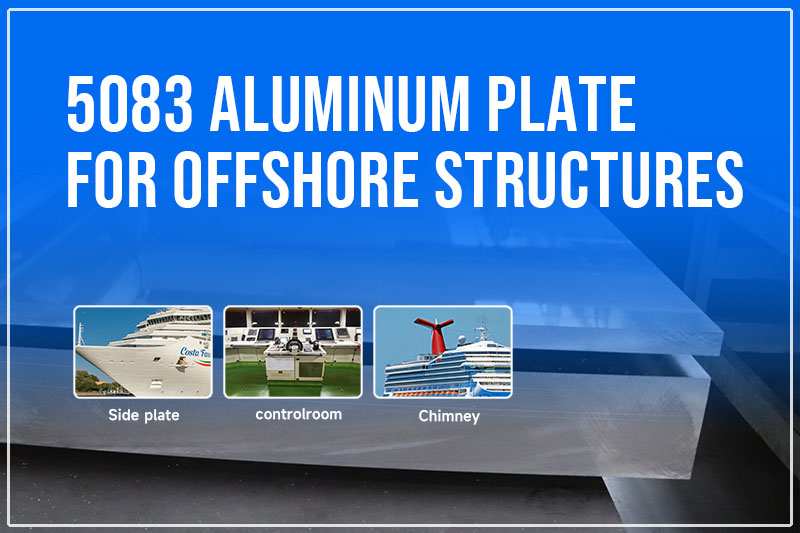
5083 aluminum plate is used across a wide range of offshore structures, including:
* Platform decks and access walkways
* Structural panels and reinforcement sections
* Support frames and brackets
* Marine equipment housings
* Ship-related structural components
These applications require a combination of corrosion resistance and structural integrity, especially where long service life is expected.
To ensure the material matches the project requirements, several factors should be evaluated together:
1. Temper and mechanical properties
The chosen temper should align with both environmental exposure and structural demands.
2. Thickness and dimensions
Proper thickness ensures load-bearing capacity while avoiding unnecessary weight.
3. Standards and certification
Compliance with recognized standards helps ensure consistent quality.
4. Surface consistency
Uniform surface condition supports fabrication and structural reliability.
5. Supply capability
Stable supply and consistent quality are essential for large or ongoing projects.
Looking at these elements collectively provides a more reliable basis for decision-making.
Material selection often involves comparing alternatives:
5083 vs 5052
5083 offers higher strength and is better suited for demanding offshore structures.
5083 vs 6061
6061 is widely used in general engineering, but 5083 performs better in marine corrosion environments.
For projects exposed to seawater over extended periods, this difference becomes critical.
A few practical considerations can improve both performance and efficiency:
* Match material properties to actual environmental conditions
* Avoid unnecessary over-specification
* Ensure compatibility with welding and fabrication processes
* Confirm traceability and documentation for quality assurance
Careful planning at the material stage can reduce long-term risks and maintenance costs.
Offshore structures require materials that can handle corrosion, stress, and time without compromise. With the right temper and proper specification, 5083 aluminum plate remains a reliable solution for demanding marine environments.
Mingtai Aluminum supplies stable and consistent 5083 aluminum plate for offshore applications. Matching the right specification to the project can help achieve better performance and long-term reliability.
What is 5083 aluminum plate used for in offshore structures?
It is commonly used in decks, walkways, structural panels, and support systems exposed to marine environments.
Which temper is best for offshore use?
H116 and H321 are widely preferred due to their enhanced corrosion resistance and stability in seawater conditions.
Is 5083 aluminum suitable for long-term marine exposure?
Yes, it offers strong resistance to corrosion and maintains performance over time.
How does 5083 compare to 6061 aluminum?
5083 provides better corrosion resistance, making it more suitable for offshore environments.
Can 5083 aluminum plate be welded easily?
Yes, it has good weldability and is commonly used in fabricated marine structures.