Aluminum Coil Surface Finish Standards are a key factor when selecting materials for manufacturing, even though they are often overlooked at the early stage. In real applications, surface condition does not only influence visual appearance, but also determines how smoothly the material performs during forming, coating, stamping, or lamination.
A coil that appears acceptable at first glance may still cause problems in production if the surface condition is inconsistent or contains hidden defects. This is why surface finish standards are closely related to both efficiency and final product quality.
Surface finish is not simply about whether the aluminum coil looks smooth or shiny. In practical terms, it includes a combination of surface uniformity, cleanliness, flatness, and defect control.
For continuous production environments, consistency across the entire coil is often more important than appearance itself. Even small variations in surface condition can interrupt automated processes or affect the stability of downstream operations.
In many cases, surface finish becomes a hidden factor behind issues such as uneven coating, poor adhesion, or unexpected forming marks.
Most aluminum coils are delivered in mill finish condition, which reflects the natural state after rolling. Instead of focusing on decorative appearance, the priority is usually whether the surface is stable and suitable for further processing.
A reliable surface condition typically includes:
* clean and contamination-free surface
* uniform texture across the coil
* controlled level of minor imperfections
* stable performance during handling and processing
For applications that require both good workability and consistent surface quality, alloys such as 3003 aluminum coil and 5052 aluminum coil are widely used. These materials are known for their balanced forming performance and stable surface behavior in industrial applications.
Surface defects are one of the main reasons for material rejection or production inefficiency. Some defects may seem minor but can create larger problems later in the process.
Typical defects include:
* Scratches: may become more visible after coating or forming
* Oil stains: can affect printing, bonding, or surface treatment
* Oxidation spots: often related to storage or environmental exposure
* Roll marks: lines or patterns formed during rolling
* Dents or pressure marks: can affect flatness and forming results
* Edge damage: may lead to issues during feeding or cutting
The key point is not to eliminate all defects completely, but to ensure they are controlled within an acceptable and consistent range.
Surface finish standards help define what is acceptable and what is not. Without clear standards, quality evaluation becomes subjective, which can lead to inconsistent results between batches.
In practical production, stable surface quality contributes to:
* smoother forming and stamping processes
* more reliable coating and printing performance
* reduced rejection rates and rework
* better consistency in final products
* improved overall production efficiency
When production volume increases, even small surface variations can result in significant cost differences.
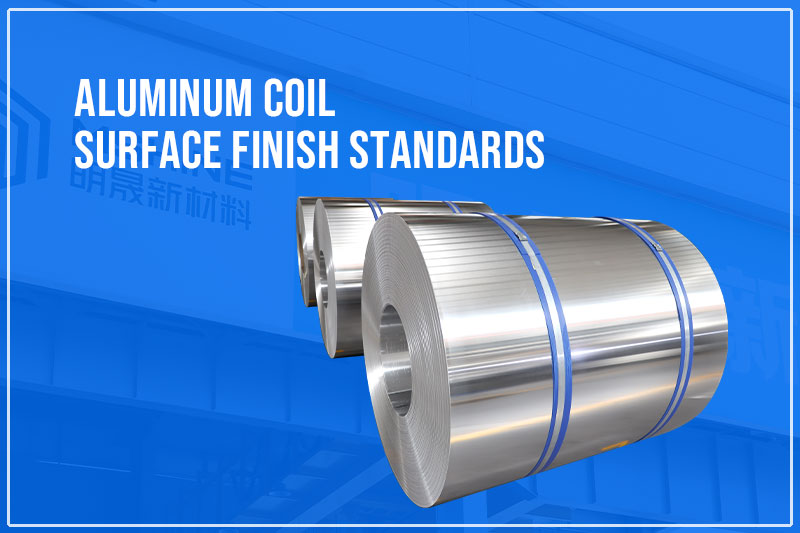
Instead of relying only on general descriptions, it is more effective to evaluate aluminum coil surface condition based on actual use requirements.
A practical evaluation method may include:
This approach reduces uncertainty and helps align material performance with real production needs.
Different applications place different priorities on surface finish, which makes it important to match the material to its end use.
For example:
* In packaging-related uses, cleanliness and consistency are critical
* In automotive or forming applications, surface stability during deformation is more important
* In construction, uniform appearance may be a key factor
* In industrial manufacturing, compatibility with further processing often takes priority
Because of these differences, the same aluminum coil surface may perform well in one application but not in another.
In many cases, a perfectly flawless surface is not necessary. What matters more is whether the surface quality is stable and predictable.
A consistent surface finish allows production processes to run smoothly without frequent adjustments. This stability is often more valuable than achieving an ideal appearance on a single batch.
Reliable supply for stable surface performance
Maintaining consistent surface finish requires stable production control and strict quality management throughout the manufacturing process. Mingtai Aluminum provides aluminum coil with reliable quality and consistent surface performance for a wide range of industrial applications, making it a dependable choice for long-term supply.
What are Aluminum Coil Surface Finish Standards?
They define the acceptable level of surface quality, including cleanliness, uniformity, and defect control.
What defects should be checked first?
Scratches, oil stains, oxidation spots, roll marks, dents, and edge damage are the most common.
Why is surface finish important in aluminum coil?
It affects processing performance, product appearance, and production efficiency.
How to evaluate surface quality before use?
By reviewing samples, confirming defect limits, and ensuring the surface matches the application.