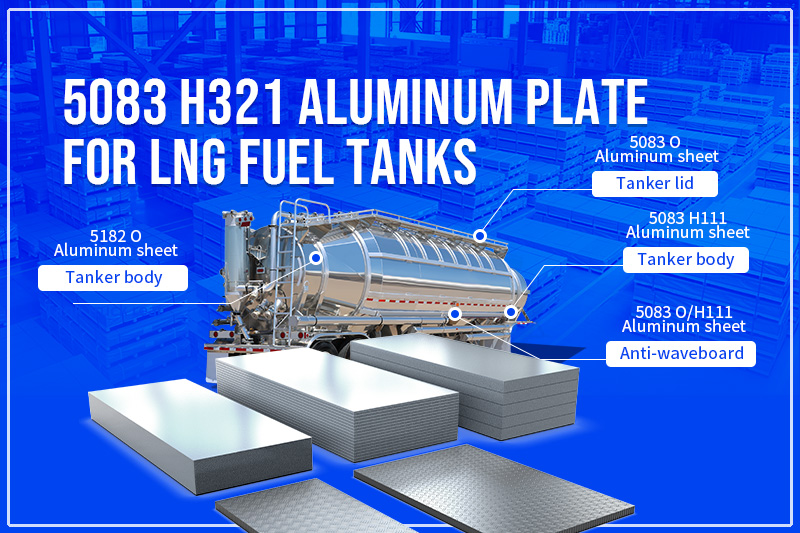
For LNG storage at -162°C, 5083 H321 Aluminum Plate for LNG Fuel Tanks offers a proven solution. Unlike carbon and stainless steels, which face brittle fracture risks at cryogenic temperatures, aluminum alloys do not undergo a ductile-to-brittle transition due to their face-centered cubic structure. Among aluminum alloys, 5083 is the highest‑strength non‑heat‑treatable alloy in commercial production, strengthened by magnesium (4.0‑4.9%) and cold working. The H321 temper undergoes specific stabilization and strain‑hardening processes, resulting in lower internal stress and better flatness—particularly advantageous for thick plates used in large LNG cargo tanks. With ASME and EN certifications, this grade is one of the most mature and reliable cryogenic aluminum materials for LNG projects.
As temperature decreases, the tensile and yield strengths of 5083‑H321 do not drop; they actually increase.
– At -196°C, the parent material’s tensile strength reaches over 90% of its room‑temperature value, and yield strength exceeds 85%.
– Charpy V‑notch impact toughness of welds and heat‑affected zones is no less than 27J, meeting the strict requirements of EN 13445 and ASME Section VIII.
– Elongation at -196°C remains above 10%, ensuring sufficient plastic deformation capacity under extreme cold.
This means that under actual LNG service conditions, the material’s load‑bearing capacity is enhanced, providing an extra safety margin for tank structures.
LNG fuel tanks often serve in marine environments or coastal terminals, where corrosion is a significant concern.
The high magnesium content of 5083 enables the formation of a dense alumina‑magnesia passive film when exposed to seawater or salt spray, effectively resisting corrosion. In ASTM G47 C‑ring stress corrosion tests (30 days in 3.5% NaCl solution), 5083‑H321 shows no cracking; it also passes ASTM G67 intergranular corrosion tests.
Service data shows that 5083 can achieve a service life of over 20 years in marine environments.
Large LNG tank and fuel tank fabrication relies heavily on welding. The weldability of 5083‑H321 is a key reason it has become an industry standard:
– Fully compatible with MIG and TIG processes, using ER5183 filler wire.
– Weld joint strength coefficient is no less than 90% of the parent metal.
– Weld metal impact toughness at -196°C is at least 27J, with lateral expansion not less than 0.38mm.
– Low hot‑cracking susceptibility; post‑weld heat treatment is not required to meet cryogenic service requirements.
This offers a practical advantage for on‑site assembly of large tanks—reducing construction time and process complexity.
In different structural parts of LNG tanks and fuel tanks, the choice of alloy and temper varies.
Preferred for 5083‑H321:
– Inner tank lower shell plates – thickness 12‑50mm, the most demanding area for cryogenic strength and stress corrosion resistance.
– Inner tank bottom plates – thickness 8‑20mm.
Suitable for 5083‑H116:
– Inner tank upper shell plates – thickness 8‑30mm.
– Roof arch plates – thickness 5‑12mm (5454‑H32 can also be used).
For marine LNG fuel tanks, 5083‑H321 is also the first choice for cargo tank wall plates. Additionally, it is widely used in onshore full‑containment LNG tank inner tanks, membrane‑type fuel containment systems, and cryogenic auxiliary equipment for offshore engineering.
5083 H321 Aluminum Plate for LNG Fuel Tanks is produced and inspected according to major international standards: ASTM B209, EN 485, and GB/T 3190.
Available dimensions:
– Thickness: 0.5mm – 500mm
– Width: up to 2650mm
– Length: up to 16000mm
Wide plates reduce weld seams in tank construction, improving overall structural integrity and fabrication efficiency.
Class society approvals obtained:
– CCS (China)
– ABS (USA)
– BV (France)
– LR (UK)
– KR (Korea)
– and others
For critical equipment like LNG tanks with design service lives of 40‑50 years, selecting internationally certified and well‑proven materials is essential for long‑term safe operation.
*This article discusses only the material properties and selection of 5083‑H321 aluminum plate as a raw material; it does not cover surface treatment or secondary processing of aluminum sheets.*
Mingtai Aluminum supplies 5083‑H321 plates with thicknesses up to 500mm and widths up to 2650mm, backed by multiple class society certifications.
Q: What is the difference between 5083‑H321 and 5083‑H116, and which should be chosen for LNG tanks?
A: H321 has lower internal stress, better flatness, and superior stress corrosion resistance; use H321 for lower shell plates and bottom plates, and H116 for upper shell plates.
Q: Does 5083‑H321 become brittle at -162°C LNG temperature?
A: No, its tensile and yield strengths increase at cryogenic temperatures, and impact toughness fully meets ASME and EN standards.
Q: Does 5083‑H321 require post‑weld heat treatment?
A: No, its low hot‑cracking susceptibility means no post‑weld heat treatment is needed for cryogenic service.