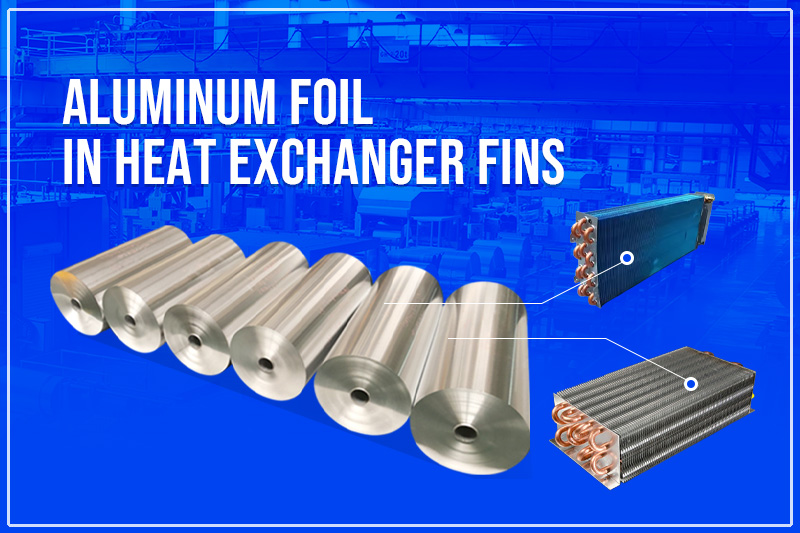
The selection of aluminum foil in heat exchanger fins directly affects heat transfer efficiency, service life, and production yield. 8011 H18 aluminum foil has become a widely used fin stock in air conditioning, refrigeration, and automotive thermal management, thanks to its balanced property set. This article reviews its material characteristics, processing adaptability, and alloy comparisons.
8011 belongs to the 8xxx series of Al‑Fe‑Si alloys. Its typical composition includes:
– Iron (Fe): 0.60–1.00%
– Silicon (Si): 0.50–0.90%
– Remainder: aluminium and minor impurities
The micro‑alloying with iron and silicon delivers two key benefits over 1xxx series pure aluminium foils:
– Higher strength
– Better resistance to pinhole formation, which improves rolling stability at thin gauges
H18 temper is the highest‑strength condition for 8011 foil. It is produced by heavy cold rolling without a final anneal.
Key mechanical characteristics include:
– Good tensile strength, adequate for high‑speed fin stamping
– Low elongation, giving finished fins excellent rigidity and shape retention
– Thermal conductivity comparable to pure aluminium, so heat exchange efficiency is not significantly compromised by the strength improvement
Fin forming involves stamping, lancing, louvre cutting, and corrugating. Material that is too soft leads to fin collapse and distortion; material that is too hard cracks at bends.
H18‑tempered 8011 achieves a good balance between strength and rigidity—enough to support precise complex shapes, while maintaining structural stability over long‑term operation.
This temper is particularly suitable because:
– Strength + rigidity – High tensile strength supports high‑speed stamping, while low elongation gives the finished fins good shape‑holding ability.
– Stable thermal conductivity – Even with iron and silicon additions, the thermal conductivity remains close to that of pure aluminium, so heat transfer is not sacrificed.
– Light weight – Low density helps reduce the overall core weight, an important factor for weight‑sensitive applications such as automotive and residential air conditioning.
When selecting a fin material, 8011 is often compared with 1100 and 3003 foil.
|
Alloy |
Key Features |
Typical Fin Applications |
|
1100 |
Pure aluminium; excellent formability and thermal conductivity, but lower strength |
Simple fins in medium‑low pressure exchangers where formability is critical |
|
3003 |
Al‑Mn alloy; higher strength and better corrosion resistance |
Brazed fins and automotive heat exchangers requiring extra strength, but at higher cost |
|
8011 |
Good balance of strength and formability; excellent rolling stability at thin gauges; stronger than 1100, more cost‑effective than 3003 |
Mainstream residential and commercial HVAC fins, refrigeration, and general heat exchanger applications |
This “middle‑of‑the‑road” positioning makes 8011 a cost‑effective choice for a wide range of fin applications.
For fin stock, 8011 H18 foil is commonly supplied in thicknesses ranging from 0.08 to 0.20 mm, with widths customized to die and production line requirements.
For high‑speed stamping lines, the following material properties are critical:
– Thickness tolerance – Poor control causes unstable stamping and higher scrap rates
– Flatness – Affects feeding smoothness and stamping precision
– Surface cleanliness – A clean surface is essential for reliable subsequent processes
8011 alloy shows good stability in thin‑gauge rolling, meeting the consistency demands of high‑speed fin lines. For applications that require extra corrosion or water‑shedding protection, additional surface treatments can be applied—but the quality and consistency of the base foil remain the foundation for any coating or finishing step.
Heat exchanger fins operate in humid and thermal cycling environments. Condensate accumulation can cause corrosion and water bridging. 8011 aluminium naturally forms a dense oxide layer that provides basic corrosion protection. In humid conditions, 8011 performs well and meets the requirements of most standard operating environments. For severe conditions such as coastal or high‑salt atmospheres, coated or post‑treated foils are available to enhance protection.
– Residential air conditioner condenser and evaporator fins
– Commercial HVAC heat exchange coils
– Refrigeration unit finned heat exchangers
– Applications where fin rigidity and thickness precision are important
– Whether the alloy and temper match the forming process requirements
– Whether thickness tolerance and flatness meet the standards of your high‑speed stamping line
– Whether the supplier can ensure consistent batch‑to‑batch performance
Base material quality directly determines fin yield and the long‑term reliability of the finished heat exchanger.-
Henan Mingtai Aluminum offers reliable 8011 H18 fin stock with consistent mechanical properties and tight dimensional control to support your high‑speed stamping operations.
Q: What is the thermal conductivity of 8011 H18 aluminium foil?
A: It is comparable to pure aluminium, ensuring efficient heat transfer.
Q: Why does H18 temper have low elongation?
A: It is fully hard‑rolled without final annealing, giving high strength and rigidity at the cost of lower elongation.
Q: Which is better for fins, 8011 or 1100?
A: 8011 offers higher strength for better rigidity; 1100 is softer and more formable for simple shapes.
Q: What is the typical thickness of 8011 H18 fin stock?
A: Common thicknesses range from 0.08 to 0.20 mm.
Q: How corrosion‑resistant is 8011 aluminium foil?
A: It naturally forms a protective oxide layer and performs well in humid environments.
Q: Which heat exchanger types use 8011 H18 foil?
A: Residential and commercial AC evaporators/condensers, refrigeration units, and automotive radiators.