This article explores the wide range of 8011 aluminium alloy applications. 8011 belongs to the 8000 series alloys, with iron and silicon as its main added elements. Compared to plain pure aluminium, 8011 offers higher strength, better formability, and excellent barrier properties. These characteristics make it a key material for packaging, pharmaceuticals, food, and industrial sectors.
In the aluminium processing industry, 8011 is commonly used in foil form, with thicknesses ranging from 0.015mm to 0.5mm. It can also be produced as aluminium strip. Different thicknesses and tempers allow 8011 to meet the needs of very different usage scenarios.
Pharmaceutical blister packaging (PTP) is one of the most demanding applications for 8011 alloy.
Why is 8011 the top choice for pharmaceutical packaging? It provides nearly 100% barrier protection against oxygen, moisture vapor, and light. Medicines are highly susceptible to moisture, oxidation, and light degradation, which 8011 foil effectively prevents.
Pharmaceutical packaging has specific requirements for 8011. For cold-formed blisters, the material needs to be in the O temper (fully soft), offering excellent elongation without cracking during deep drawing. The pinhole count is a critical indicator. Fewer pinholes mean better barrier performance. The material must also comply with strict food and drug contact standards like FDA or EU regulations, requiring a clean surface and low oil residue.
The cling foil in your kitchen, the foil for barbecue, and the liner for your air fryer are often made from 8011.
Food containers like takeaway boxes, tart trays, and airline meal trays require materials with excellent deep drawability, forming without wrinkles or cracks. For air fryer liners, 8011-H14 or H16 alloy at 15 microns thickness provides the best balance between heat resistance and tear strength.
Food lids, such as those on yogurt or jelly cups, need good heat-seal strength and stable sealing performance to prevent leaks.
The tamper-evident cap you twist off a bottle of wine or spirits is very likely made from 8011 alloy.
There is a key indicator for cap stock called the “earing rate.” A lower earing rate means the top edge of the cap is flatter during stamping. This improves appearance and reduces production waste. High-quality 8011 cap stock can control the earing rate between 0% and 2%.
The material must have good elongation to roll perfectly onto the bottle thread, while also providing enough rigidity to hold its shape and resist deformation after sealing.
8011 aluminium strip offers good electrical conductivity and corrosion resistance. It is widely used for cable shielding layers to protect signals from interference.
Additionally, 8011 has a high reflectivity for thermal radiation. It is used as reflective insulation in buildings or equipment, such as the aluminium foil layer in sandwich panels. In these applications, flatness and corrosion resistance are key factors to consider.
8011 is also used to manufacture heat dissipation fins for air conditioner condensers and evaporators. These applications require good thermal conductivity. The base material’s corrosion resistance also provides a reliable foundation for any subsequent surface treatments.
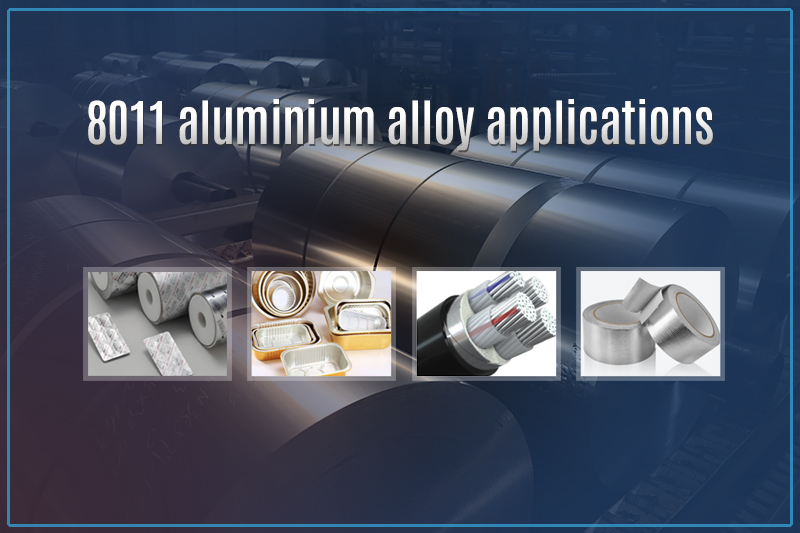
Many customers ask: What temper of 8011 should I choose?
Here is a simple guide:
– O Temper (Soft): Best for deep drawing applications like pharmaceutical blisters and food containers. It offers maximum elongation.
– H14/H16 Temper (Half Hard): Suitable for applications needing a balance of strength and formability, such as some food lids and bottle caps.
– H18/H19 Temper (Full Hard): Best for applications requiring high rigidity, like the backing foil for pharmaceutical blisters or cable shielding tape.
Choosing the correct temper ensures the material performs optimally on your production line.
When you are sourcing 8011 material for pharmaceutical, food, or industrial use, here are a few key dimensions to evaluate:
For continuous production facilities, inconsistent material is a major risk. Variations in thickness tolerance or mechanical properties can lead to machine stoppages, increased tool wear, and high scrap rates.
A good supplier should have full-process quality control. This includes controlling the chemical composition from the melting and casting stage and using advanced rolling mills to ensure precise shape and thickness. For example, Mingtai Aluminum operates a fully integrated production line, achieving thickness tolerances of ±0.005mm to ensure consistency across thousands of tons of shipments.
Your equipment, molds, and final products are unique. You may not need standard specifications, but rather specific widths, coil diameters, or tensile strength ranges.
Can the supplier cover thicknesses from 0.012mm to 0.5mm? Can they adjust elongation and earing rate based on your stamping process? Can their process engineers work directly with your technicians? These are important indicators of a supplier’s professional capability.
Beyond chemical composition, pay attention to the key indicators relevant to your specific use case: pinhole count for pharmaceutical foil, earing rate for cap stock, and cupping test values for deep-drawing materials. A professional supplier should understand the importance of these metrics for your application and provide stable, reliable performance. Understanding these detailed 8011 aluminium alloy applications helps in specifying the right material.
Looking for stable, high-performance 8011 aluminium alloy? With 27 years of experience, Mingtai Aluminum (stock code: 601677) provides reliable quality for everything from pharmaceutical foil to bottle cap stock. Contact us for a consultation.
Q: What is the difference between 8011 and regular household foil?
A: 8011 is a specific alloy with added iron and silicon. It offers higher strength and better formability for demanding applications like pharmaceutical packaging and bottle caps.
Q: How do I choose the right temper for pharmaceutical packaging?
A: For cold-formed blisters, choose O temper. For PTP blister backing foil, choose H18 or H19 temper for stiffness.
Q: Is 8011 foil safe for food contact?
A: Yes, if it meets FDA or EU standards. 8011 is chemically inert and will not react with food. Always verify compliance for your target market.
Q: What is the difference between 8011 and 8079?
A: 8011 offers better formability and puncture resistance, making it ideal for deep-drawing applications like blisters. It is the more common choice.
Q: What key parameters should I check when buying 8011?
A: Check temper, mechanical properties, and application-specific indicators like earing rate for caps or pinhole count for pharmaceutical foil.