When sourcing aluminum plate, a common question arises with aluminum T6 vs T651: both are 6061 alloy, but what’s the real difference?
Many assume T651 is simply an “upgraded” version of T6, or that they are essentially the same. But in actual use, the difference is clear—some buy T6 and find their parts distort during machining; others choose T651 and enjoy significantly higher yield rates.
Let’s clarify the real difference between T6 and T651, and how to choose correctly.
To grasp the difference, we need to look at the process.
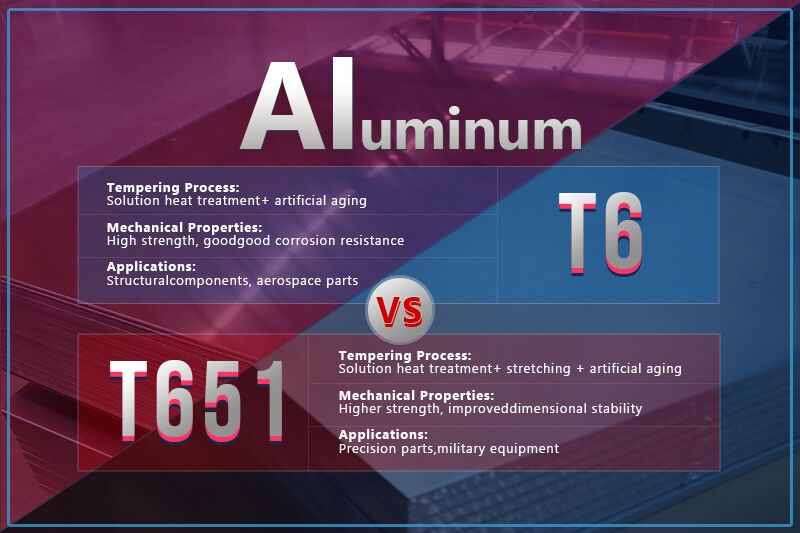
T6 Condition: The plate undergoes solution heat treatment and artificial aging to achieve required strength. But the quenching process introduces internal stress—like a tightly twisted towel that looks fine until you let go and it deforms.
T651 Condition: This adds one extra step after T6—stretching to relieve stress. The plate is permanently stretched by 1% to 3%, releasing that internal tension. This “pre-stretching” is what the “1” signifies.
So T651 has the same strength as T6, but with much lower internal stress—it’s more “relaxed” internally and less prone to deformation during machining.
|
Aspect |
T6 Aluminum |
T651 Aluminum |
Selection Guide |
|
Internal Stress |
High |
Very low (pre-stretched) |
Parts with heavy machining must use T651 |
|
Strength |
High |
Same as T6 |
No difference in mechanical properties |
|
Machining Stability |
Prone to warping |
Dimensionally stable |
CNC work, precision parts: choose T651 |
|
Flatness |
Possible waviness |
More consistent |
Large plates, tight tolerances: choose T651 |
|
Typical Uses |
Simple brackets, shims |
Precision jigs, molds, aerospace |
Depends on your precision requirements |
If you’ll be milling slots, drilling holes, or machining thin walls, choose T651 directly.
With T6, removing material releases internal stress—parts can distort and scrap. T651 is pre-stretched, so it maintains dimensional stability after machining. Every machinist understands this.
Welding heat releases stress. With T6, expect significant distortion and lengthy correction work. With T651, lower initial stress means noticeably less post-weld distortion—saving time and effort.
If you’re just cutting plates into strips for backing or support, with no flatness requirements, T6 is perfectly adequate and more economical.
Choosing the right material is half the battle in successful machining.
Mingtai Aluminum specializes in producing 6061 T6 and T651 plate with strict process control and consistent quality. Whether you need precision-graded T651 stress-relieved plate for demanding applications or standard T6 plate for general use, we offer a full range of thicknesses and sizes to support your next project.
Understanding the aluminum T6 vs T651 difference is the first step toward better results and lower costs.
Q1: Is T651 more expensive than T6?
A: Yes, slightly—the extra stretching step adds cost. But for precision work, T651’s lower scrap rate and reduced straightening time often make it more economical overall.
Q2: Is the hardness the same as T6?
A: Yes. Both meet the same 6061-T6 hardness standard. The difference is in internal stress, not hardness.
Q3: How can I tell T6 and T651 apart when buying?
A: Check the mill test report. Reputable suppliers clearly mark the temper as “T651.” Mingtai provides traceable certification with every shipment.
Q4: Can I buy T6 and process it into T651 myself?
A: No. Pre-stretching requires specialized equipment during plate production. Subsequent heat treatment cannot replicate it—order the correct temper from the start.