In power, telecom, and data transmission, aluminum foil for cable wrapping plays an essential role in shielding and protection. It is applied over the cable core by longitudinal or spiral wrapping, providing electromagnetic interference (EMI) shielding, moisture resistance, oxidation protection, and physical defense. Different cables have very different requirements for thickness, alloy, and mechanical properties. Choosing the wrong parameters can lead to shielding failure or production breaks, so understanding the core specifications is critical.
Aluminum’s electrical conductivity creates a reflective layer that blocks external electromagnetic waves and prevents signal leakage from the cable core. In addition, the dense aluminum layer stops moisture and oxygen, significantly slowing the aging of insulation and sheathing materials. Compared to copper foil, aluminum foil costs less and weighs less, with typical thicknesses between 0.01 and 0.2 mm. It fully meets the flexibility and bending requirements of spiral wrapping processes.
1. Alloy and temper
Common alloys include 1235 and 8011. 1235 has an aluminum purity of ≥99.35% and excellent ductility, making them suitable for thin, tight wrapping. 8011 has slightly higher strength and is used for medium‑thick cables where some tensile strength is needed. Most cable wrapping uses the soft temper (O temper) to ensure no cracking during bending.
2. Thickness tolerance and width accuracy
Typical thickness ranges from 0.01 mm (for thin shielding tapes) to 0.20 mm (for waterproof layers in power cables). Thickness tolerance should be kept within ±5%, and width tolerance within ±0.5 mm. Excessive tolerance directly leads to poor overlap or uneven wrapping, affecting shielding uniformity along the entire cable.
3. Mechanical strength and elongation
Tensile strength is generally between 50 and 110 MPa, depending on alloy and temper. Elongation is a key indicator of flexibility. For soft‑temper foil, elongation of at least 1% is required, while high‑quality products can reach over 10%. If elongation is too low, the foil will tear even under slight wrapping tension, causing frequent production stops.
4. Pinhole density and surface cleanliness
Pinholes directly break shielding continuity. High‑quality foil should have no more than 5 pinholes per square meter. At the same time, residual rolling oil or oil spots on the surface will reduce adhesion to the cable sheath. Inspection reports on cleanliness should be requested from the supplier.
5. Surface wetting tension (dyne level)
If the foil needs to be laminated with PE, PET, or hot‑melt adhesive (for example, aluminum‑plastic composite tape), the surface wetting tension should be ≥31 mN/m. Otherwise, the bond will be weak, and the sheath may delaminate later.
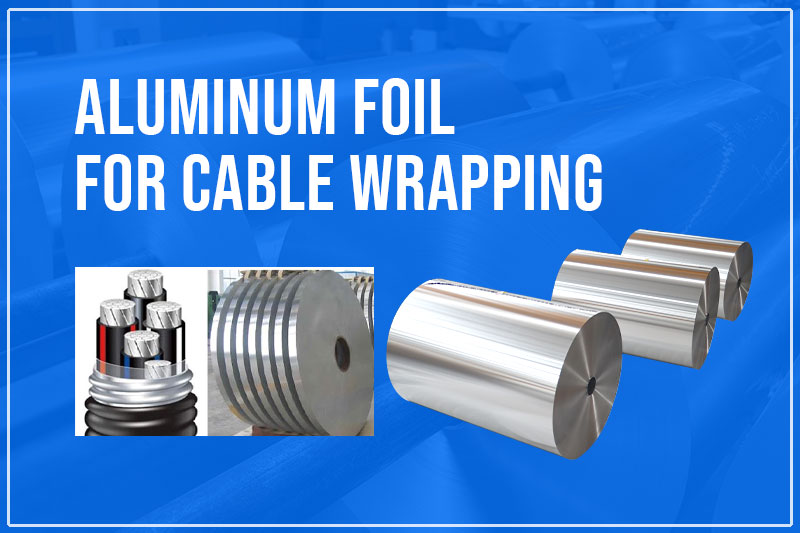
– Medium and low voltage power cables: Mainly used as a water barrier combined with grounding shield. Recommended thickness: 0.15–0.20 mm. Key requirements are high tensile strength and good bonding with hot‑melt sheathing.
– Telecommunication cables (e.g., telephone wires): Used to prevent crosstalk and external EMI. Thickness is usually 0.01–0.025 mm. Extremely low pinhole count is required, and the foil is often longitudinally laminated with PET film.
– Coaxial cables: Used to stabilize characteristic impedance. Thickness: 0.02–0.05 mm. Very high uniformity of thickness and surface smoothness is needed – any local bump will change the impedance.
– Data cables and USB cables: Used for high‑frequency noise suppression. Thickness around 0.01 mm (often as an aluminum‑plastic tape). The key point is fatigue life under repeated bending, because these cables are flexed frequently.
– Check the number of splices: Inside a large roll of 1000 meters, there should be no more than 3 splices. Too many splices cause frequent production stops.
– Request test reports: For each batch, get measured data on tensile strength, elongation, pinhole count, thickness tolerance, and width tolerance.
– Run a trial wrapping with a free sample: Put the foil on your wrapping machine and observe whether there is breakage, slipping, or edge burrs.
– Check certifications: ISO 9001, RoHS, REACH, etc., are basic requirements.
Many production experiences show that tearing during wrapping usually comes from two reasons: first, elongation below 1.5% – the foil breaks even with slight tension variation; second, micro‑cracks or burrs on the slit edges, causing stress concentration and tearing. The solution is straightforward: choose soft‑temper (O) foil with elongation greater than 5%, and randomly inspect a sample with a magnifying glass for edge smoothness upon arrival.
Choosing reliable aluminum foil for cable wrapping directly affects your finished cable’s pass rate and production costs. Mingtai Aluminum provides high‑purity, dimensionally accurate, and batch‑consistent foil for all types of cable wrapping, with custom widths and complete mechanical test reports available.
Q1: What is the most commonly used alloy for cable wrapping aluminum foil?
A: 1235 and 1145 (high purity, ductility); 8011 for higher strength.
Q2: Does thicker foil always provide better shielding?
A: No – shielding depends on continuity and pinholes, not thickness.
Q3: How can I quickly check if the foil’s elongation is acceptable?
A: Bend by hand; good foil survives 5–6 bends, brittle foil breaks in 1–2.
Q4: Why do wrinkles or ripples appear on the foil after wrapping?
A: Poor width tolerance or uneven tension.
Q5: Does cable wrapping foil need to be pre‑coated with adhesive?
A: Only if using aluminum‑plastic composite tape or hot‑melt sheath requires it.