In the critical structures of ships braving the waves and heavy-duty vehicles transporting goods, material choice directly dictates performance and longevity. When engineers seek an aluminum-magnesium alloy that balances good strength, exceptional corrosion resistance, and excellent formability, the aluminum 5754 H111 plate often emerges as the premier solution. This article provides an in-depth analysis of the core characteristics, applications, and selection criteria for this versatile “marine-grade” alloy.
Alloy 5754 belongs to the Al-Mg series of non-heat-treatable, corrosion-resistant alloys. Its key characteristic is the Magnesium (Mg) content (approx. 2.6-3.6%), which significantly enhances strength. Working in synergy with elements like Manganese (Mn), it grants the alloy superior resistance to corrosion, particularly in chloride-rich marine environments.
The temper designation “H111” is equally crucial. It indicates the sheet has been strain-hardened and then partially annealed at a low temperature. This process retains some of the strength from work-hardening while offering better formability than fully hard tempers like H14 or H24. In essence, H111 represents the ideal balance between strength and ease of fabrication, making it perfectly suited for components requiring subsequent bending or moderate forming.
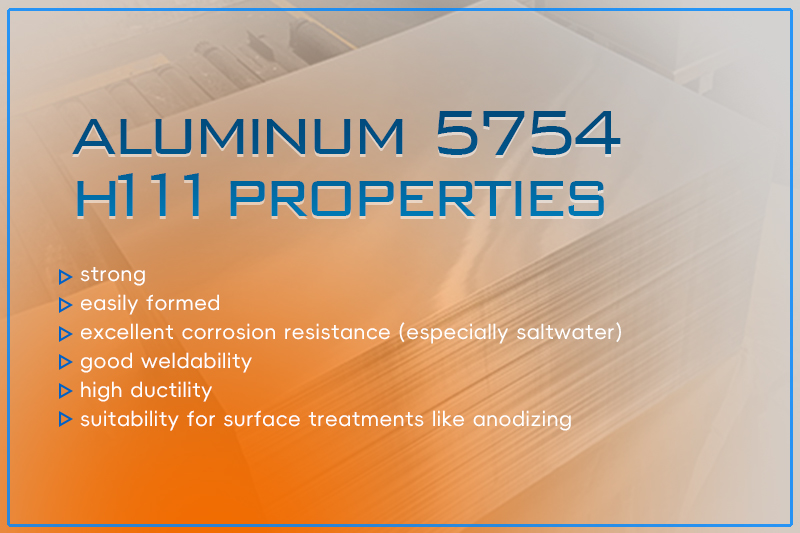
Material Selection Comparison:
* Versus 5052 H32, 5754 H111 offers higher strength and better corrosion resistance, serving as an upgrade for more demanding environments.
* Versus 5083 H111/H321, 5754 H111 provides slightly lower strength but better formability and often a more competitive cost, making it a value-driven choice for many medium-to-high-strength applications.
Thanks to its balanced profile, 5754 H111 is widely used in:
* Shipbuilding & Marine Engineering: Hull plates, decks, bulkheads, superstructures, and offshore platform components. Its marine corrosion resistance is key. [Link to “Marine Aluminum Plate” page].
* Transportation & Automotive: Truck and trailer bodies, tanker trailers, refrigerated van panels, automotive chassis parts, and public transport structures. Lightweighting and durability are crucial here. [Link to “Transportation Aluminum Sheet” page].
* Pressure Vessels & Tanks: Chemical transport tanks, brewery vessels, and cryogenic containers. Its weldability and corrosion resistance ensure safety and purity.
* General Engineering & Architecture: Machinery guards, frames, and architectural cladding requiring good strength and weatherability.
Mingtai Aluminum Recommendation: As a leading producer of aluminum sheet, plate, and foil, Mingtai Aluminum supplies 5754 H111 plates with precise composition, stable performance, and tight dimensional tolerances, fully compliant with high-end application standards. We offer various sizes and custom cutting services, providing reliable material solutions for your marine, transportation, and engineering projects. Contact our technical sales team today for detailed specifications or to request a sample to evaluate the aluminum 5754 h111 properties for yourself.
Q1: Which is more corrosion-resistant, 5754 H111 or 5083 H111?
A1: Both are excellent, with 5083 having a slight theoretical edge. However, 5754 H111 provides outstanding marine corrosion resistance that meets the vast majority of application requirements, often with better formability and cost-effectiveness.
Q2: Can 5754 H111 be used for deep drawing?
A2: The H111 temper is optimized for moderate forming, like bending and shallow stamping. For complex deep drawing, starting with an O (annealed) temper is generally recommended, followed by work-hardening if needed.
Q3: Are there special considerations for welding 5754 H111?
A3: It welds well using standard methods. For best results, use 5183/5356 filler wire and control heat input to minimize softening in the weld area. Critical structures may require specific post-weld design considerations.