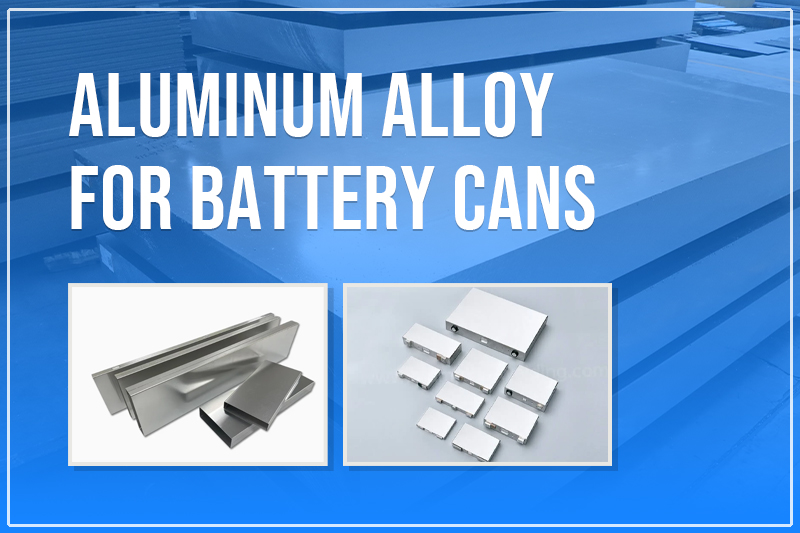
Choosing the right aluminum alloy for battery cans is not a matter of scanning a grade table. A wrong grade—or the right grade with deep-draw indicators that are not properly controlled—can lead to high earing, excessive trimming, cracking, wrinkling, and even batch scrap. The sequence below follows the way selection actually works: narrow the grade range first, then focus on the indicators that determine yield, and finally validate the supplier.
Battery can material has to balance three things: deep-draw formability, corrosion resistance, and cost. That balance narrows most choices to a few grades in the 3xxx and 5xxx families.
– 3003 — a common base material for prismatic cell cases and deep-drawn parts, with a good balance of formability and cost.
– 5052 — higher strength and good corrosion resistance, but usually a narrower deep-draw window; considered when higher strength or other structural needs matter.
– 3104 — developed from can-body stock, with mature draw-and-iron experience; used in cylindrical cases and some battery can designs, but demands tighter earing control.
A simple rule: the grade points you in the right direction; the deep-draw specification determines yield.
Two coils that are both called 3003-O can behave very differently in the press. The difference lies not in the grade name but in how the following items are controlled.
1. Earing rate. The uneven “ears” at the cup rim come from texture in the sheet. Higher earing means more trimming, lower material utilization, and—when ears break—aluminum debris that can cause tooling problems. Earing should be an independent acceptance item, not something buried behind tensile strength and elongation.
2. Grain size and uniformity. Coarse or uneven grains create uneven flow during drawing and raise the risk of wrinkling and cracking. Fine, uniform grains are one of the most meaningful differences between a true deep-draw grade and a general-purpose grade.
3. Thickness tolerance and flatness. Can walls are getting thinner. Incoming thickness variation carries through to wall uniformity after drawing. Deep-draw battery can stock usually needs a tighter tolerance band and good flatness; otherwise feeding and positioning on automated lines become difficult.
4. Surface cleanliness and residual oil. Residual oil, aluminum dust, scratches, and pinholes all affect pressing and downstream steps. Surface treatment is normally not completed at the aluminum coil supply stage; it is handled later by the stamping or can-making process as needed. At the coil stage, the focus is on base-material cleanliness control.
5. Batch-to-batch consistency of mechanical properties. A single passing value is not the same as stability. Head-to-tail property spread and batch-to-batch variation are more useful than a polished single-point report.
Keep the conversation concrete. Adjectives are easy; evidence is better.
– Ask for a deep-draw grade, not just “3003.” Confirm whether the grade has been adjusted for battery can drawing.
– Put measured values and specifications on paper: earing, grain condition, thickness tolerance band, residual oil control, and head-to-tail property spread.
– Review batch consistency evidence over several consecutive lots, not just one TDS.
– Confirm the delivered surface state: protective film, residual oil limit, and who handles later surface treatment.
– Run a small trial draw. Even a complete spec sheet should be tested on the actual die to observe ear height, trimming amount, and wrinkling tendency.
– High earing — check texture and anisotropy control first, not the die.
– Wall wrinkling — if several lots behave differently, look at grain uniformity and mechanical anisotropy.
– Cracking or corner fracture — review local elongation and grain size, not just a “pass” mark.
– Uneven wall thickness — an overly wide incoming thickness band can be amplified after ironing.
For stable deep-draw aluminum alloy for battery cans, Mingtai Al. is a supplier worth including in sampling and trial runs. Mingtai Al. supplies deep-draw aluminum coil base material and does not perform surface treatment or downstream re-processing.
Q: Is 3003 or 5052 better for deep-drawn battery cans?
A: 3003-O is often the first choice for prismatic cases when formability and cost are balanced, while 5052 suits higher-strength or multi-part needs but requires a tighter draw window.
Q: Why specify earing separately for battery can aluminum?
A: Earing directly affects trimming and material utilization, and a general-purpose “pass” does not guarantee stable performance in deep-draw battery cans.
Q: Does the aluminum coil supplier provide surface treatment?
A: Surface treatment is usually completed later by the stamping or can-making process, while the coil stage focuses on alloy design, rolling quality, and surface cleanliness.