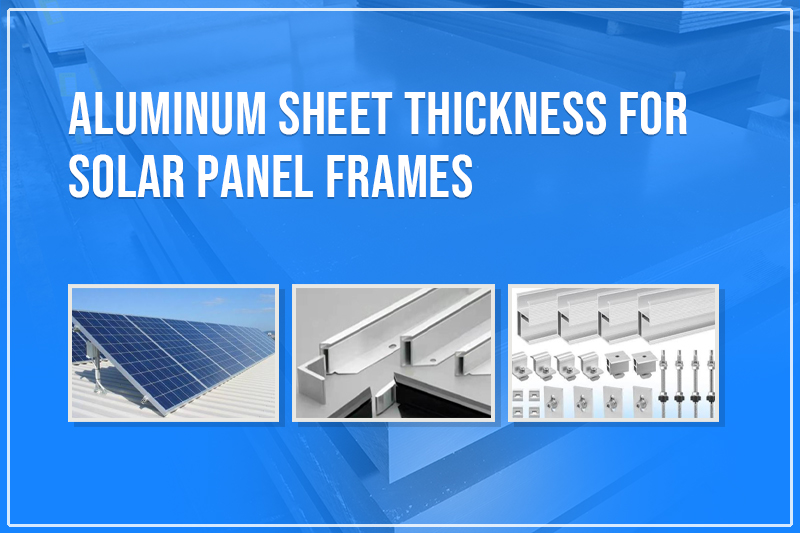
Designing and manufacturing durable solar PV modules requires structural frame elements that serve as the protective backbone of the entire assembly. These metal profiles must endure severe wind loads, heavy snow pressure, and decades of environmental exposure without compromising long-term module stability.
Selecting the appropriate aluminum sheet thickness for solar panel frames plays a decisive role in defining structural rigidity, total package weight, and raw material costs. Finding the ideal dimension ensures optimal structural safety without exceeding project budgets.
Aluminum materials engineered for solar frames and structural mounting components generally span from 1.2 mm to 3.0 mm in thickness. Each specification range addresses distinct mechanical requirements across various operating environments:
* 1.2 mm – 1.5 mm (Lightweight & Portable Systems)
Designed for low-wattage solar panels, foldable mobile chargers, and weight-sensitive rooftop mounting arrays where structural loads remain minimal.
* 1.5 mm – 2.0 mm (Commercial & Standard Industrial Modules)
Represents the primary thickness range across the global PV industry, delivering an optimal balance between flexural stiffness and roll-forming workability.
* 2.5 mm – 3.0 mm+ (Heavy-Duty & Extreme Weather Installations)
Utilized for ground-mounted solar utility farms in severe climate zones, including high-wind coastal belts and high-altitude heavy snow regions.
Site conditions dictate exact material specifications. Mechanical loads vary significantly depending on geographic location and installation layout:
Coastal regions and alpine areas require thicker aluminum substrates to resist high tensile stress and prevent frame deformation under extreme load conditions.
Steep mounting angles and wide support spans concentrate mechanical stresses across the frame edges. Increasing sheet thickness mitigates frame warping, protecting internal solar cells from micro-cracking.
> Key Rule: Higher environmental loads and extended mounting spans necessitate either increased wall thickness or elevated alloy mechanical properties to maintain structural safety.
Thickness decisions depend heavily on material grade selection and overall budget parameters:
* High-Strength Alloys (6061 / 6063): High yield strengths permit thinner profile walls while satisfying strict structural safety factors, reducing overall package weight.
* Formable Alloys (5052 / 3003): Superior corrosion resistance and bendability allow for custom profiles, requiring precise thickness calculations based on bending radii.
* Every 0.1 mm increase in material thickness raises raw material consumption and total logistics weight proportionally.
* Optimization Strategy: Identifying the thinnest viable dimension that satisfies safety requirements is essential for controlling overall manufacturing costs.
Automated frame forming, punching, and corner-locking processes require consistent raw material input. Precise thickness tolerances, flat surface profiles, and uniform internal grain structures determine overall manufacturing yields.
As a primary mill-finish producer, we deliver top-tier mill-finish aluminum sheets and coils engineered directly for framing fabricators.
> Note: We specialize strictly in supplying prime mill-finish aluminum sheets and coils directly from our mills, without secondary surface treatments (such as anodizing or coating) or secondary fabrication services. Tight thickness tolerances and exceptional flatness ensure seamless integration into automated forming lines.
Choosing the ideal aluminum sheet thickness for solar panel frames forms the foundation of reliable PV module manufacturing. Matching material specifications to real-world operating conditions ensures durable performance and product marketability.
Looking for high-precision mill-finish aluminum substrates? Mingtai Al supplies premium mill-finish aluminum sheets and coils across custom thicknesses and alloys to support your large-scale manufacturing needs.
Q: What is the most common thickness used for standard solar panel frames?
A: Standard solar panel frames typically utilize thicknesses between 1.5 mm and 2.0 mm to balance strength and cost.
Q: Does alloy choice affect the necessary aluminum sheet thickness for solar panel frames?
A: Yes, higher-strength alloys allow for slightly thinner sheet dimensions while maintaining equal structural load capacity.
Q: How do thickness tolerances affect automated frame production?
A: Strict thickness tolerances prevent material jamming and ensure consistent dimensions during high-speed punching and bending.
Q: Do you supply aluminum sheets with anodizing or surface coatings?
A: No, we supply raw, mill-finish aluminum sheets and coils without surface treatments or secondary processing.
Q: Can mill-finish aluminum coils be fed directly into continuous framing lines?
A: Yes, our mill-finish coils offer excellent flatness and uniform mechanical properties suitable for high-speed roll forming.