The global automotive industry is accelerating toward lightweighting. Aluminum coil for automotive applications offers low weight, high energy absorption, and excellent corrosion resistance. It has become a core material for body panels, chassis, and electric vehicles. This guide covers applications, alloy selection, quality parameters, and a practical decision framework – all ready for your purchasing process.
Aluminum has only one‑third the density of steel. A 10% weight reduction in a vehicle improves fuel efficiency by 6–8%. For electric vehicles, lighter bodies directly extend driving range. At the same time, aluminum absorbs twice as much crash energy per unit weight as low‑carbon steel – lighter, yet safer.
These benefits are driving rapid growth in the global automotive aluminum market. Whether you are a buyer, engineer, or manager, understanding how to choose aluminum coil will help you make better decisions.
Aluminum coil covers four main areas:
Body outer and inner panels
Hoods, doors, fenders, decklids. Outer panels need surface quality and dent resistance; inner panels require complex formability and weld stability.
Chassis and structural parts
Subframes, suspension arms, crash beams. The high strength‑to‑weight ratio reduces unsprung mass and improves handling.
Thermal management systems
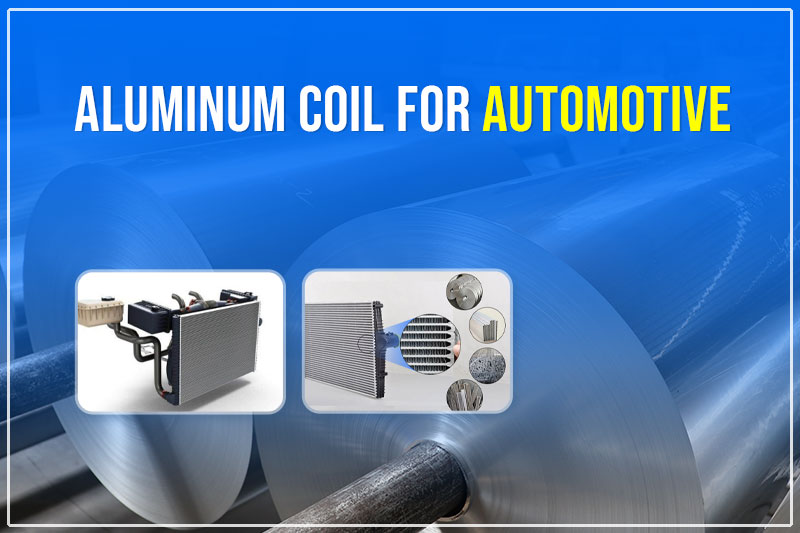
Radiators, condensers, charge air coolers. Aluminum’s excellent thermal conductivity makes 3xxx and 1xxx alloys the top choices.
EV‑specific components
Battery enclosures, motor housings, battery trays. Aluminum provides electromagnetic shielding, light weight, and corrosion resistance – critical for range and safety.
Four series dominate automotive coil applications. Each has a clear role:
5xxx series (e.g., 5052, 5182, 5754)
Magnesium is the main addition. Not heat‑treatable. Excellent formability, weld stability, and corrosion resistance. Best for inner panels, complex‑shape parts, and sealing components.
6xxx series (e.g., 6061, 6016)
Silicon and magnesium. Heat‑treatable. After paint baking, hardness increases by 30–50 MPa. Superior surface quality. Ideal for outer body panels (Class A surfaces), structural parts, and suspension arms.
3xxx series (typical grade 3004‑O)
Manganese added. In the O‑temper (annealed) condition, it offers outstanding elongation. Good balance of formability, corrosion resistance, and cost. Used for radiator cores, condensers, and some structural parts.
1xxx series (e.g., 1100)
Commercial pure aluminum. Best electrical and thermal conductivity, but lowest strength. Mainly for heat exchanger cores and electrical conductors.
> Practical tip: Need outer panel hardness and dent resistance? Go with 6xxx. Complex deep drawing and high weld yield? Choose 5xxx. Thermal management? Consider 3004‑O or 1100.
When requesting quotes and inspecting material, verify these five items:
– Thickness tolerance – Top suppliers achieve ±1%. Directly affects stamping consistency.
– Flatness – Automotive grade requires ≤5 I‑units. Poor flatness ruins welding and painting.
– Surface roughness (Ra) – 0.2–0.8μm. Too high or too low causes lubrication or adhesion problems.
– Mechanical properties – Tensile strength from 80 to 320 MPa (depending on alloy), elongation ≥15%. This is the minimum for avoiding cracking.
– Inspection system – Ask for online surface scanning, X‑ray thickness measurement (±0.1% accuracy), and OES melt analysis reports. Defect PPM should be below 50.
About 78% of surface defects come from the rolling process, not shipping. Choosing a supplier with strong in‑process control is more reliable than relying on final inspection alone.
Here are hard numbers to support your decision:
– Replacing steel with aluminum for engine hoods and doors reduces weight by about 30%.
– An aluminum radiator is 20–40% lighter than a copper/brass one.
– A 10% vehicle weight cut improves fuel economy by 6–8%.
– For EVs, an aluminum battery enclosure is tens of kilograms lighter than steel – adding tens of kilometers of range.
– In a crash, aluminum absorbs twice the energy per unit weight of mild steel, giving a larger safety margin.
These figures lower operating costs and help meet tightening emission and ESG requirements.
Step 1 – Identify the application
– Outer panels (hoods/doors) → 6xxx series
– Inner panels / deep‑drawn parts → 5xxx series or 3004‑O
– Heat exchangers → 3xxx or 1xxx series
– EV battery enclosures → 6xxx for strength, 5xxx for weldability
Step 2 – Prioritize mechanical performance
– Tensile ≥250 MPa → 6xxx or 5182
– Elongation first (to avoid cracking) → O‑temper or 5xxx
– Weld yield first → 5xxx series
Step 3 – Match supplier’s size capabilities
Verify that the supplier can deliver thickness from 0.2 to 6.0 mm, width from 100 to 2650 mm, and holds IATF16949 (automotive quality management certification).
Q1: Can an aluminum coil really match the safety level of steel?
A: Yes – aluminum absorbs twice the crash energy per unit weight of mild steel, so a well‑designed structure can be equally safe while much lighter.
Q2: How do I choose between 5xxx and 6xxx for body parts?
A: Outer panels → 6xxx (bake hardening and surface quality). Inner panels → 5xxx (better formability and weld stability).
Q3: What are the typical parts for 3004‑O aluminum coil?
A: Hood inners, door panels, chassis structural parts, radiators, and condensers.
Q4: How can I quickly tell if a coil supplier is reliable?
A: Check for IATF16949 certification, thickness tolerance ≤±1%, and whether they provide online inspection reports.
Q5: What is the most common quality defect when buying aluminum coil for automotive use?
A: Roller marks and scratches. About 78% originate from the rolling process – focus on the supplier’s rolling and inspection capabilities during your audit.
Mingtai Aluminum offers automotive‑grade coils covering 3xxx/5xxx/6xxx series, with thickness and width ranges matching mainstream tooling requirements, and holds IATF16949 certification. From application consulting to stable delivery, we aim to be a reliable partner for your lightweighting projects.