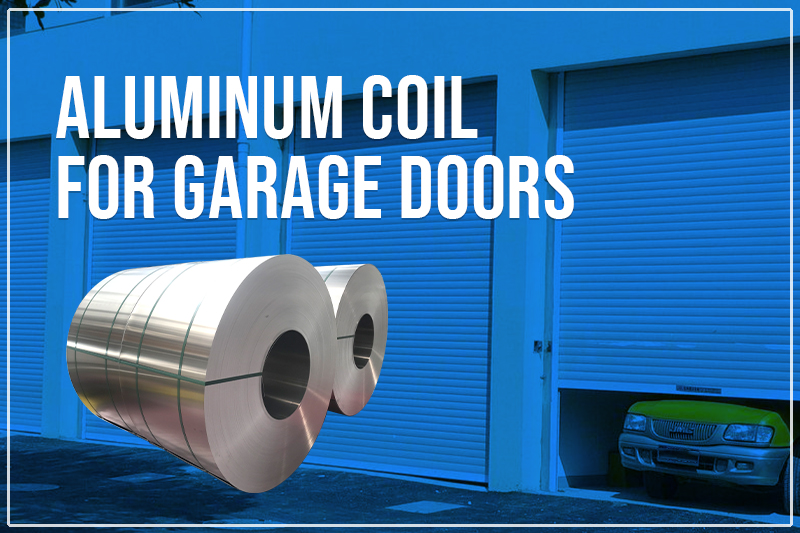
Choosing the right aluminum coil for garage doors is half the battle. Garage doors open and close dozens of times a day, face sun, rain, and wind year-round, and need to look good while staying secure. Too soft a panel dents easily; too hard a material resists forming. Which coil meets all demands for strength, formability, and corrosion resistance? 3004 H34 aluminum coil strikes that balance perfectly.
3004 aluminum is an Al-Mn-Mg alloy, with manganese (1.0%–1.5%) and magnesium (0.8%–1.3%) as the main additions. Manganese boosts strength; magnesium further enhances corrosion resistance. The H34 temper means the material is strain-hardened and then stabilised – placing it between the soft O-temper and the fully hard H38.
So what does H34 strength actually deliver?
– Tensile strength reaches above 215 MPa – enough to resist minor impacts without permanent dents.
– Yield strength stays around 170 MPa, so the panel won’t easily deform under normal loads.
In short: strong enough for daily use, yet not so hard that it becomes difficult to work with.
Garage door panels go through roll forming, punching, hemming, and bending. If the material is too hard, it cracks; if too soft, it loses shape.
3004 H34 offers elongation in the range of 10%–17%. That margin allows it to adapt to die contours during roll forming without tearing from local over-stretching. Whether it’s:
– Curved slats for rolling doors, or
– Reinforced ribs for sectional panels
3004 H34 handles both with ease.
Bottom line: strong enough for duty, yet formable without extra effort – the very balance that matters most in garage door production.
Garage doors live outdoors – rain, humidity, and coastal salt spray are everyday threats.
The manganese in 3004 alloy forms a dense oxide film on the surface, providing effective protection against atmospheric corrosion and industrial pollutants.
This advantage matters most for:
– Projects near coastlines
– Garages in high‑humidity regions
Unlike steel, aluminium never rusts. That means lower maintenance costs and a longer service life for the end product.
The most frequent question when choosing material: “Why not 3003? Why not pure aluminium?”
Here’s a direct side‑by‑side look:
3004 contains magnesium, which gives it significantly higher strength. 3003 has a tensile strength of roughly 150 MPa, while 3004 H34 reaches above 215 MPa. For garage doors that demand better impact resistance and dent resistance, 3004 is the more reliable choice. Use 3003 for standard-duty applications; choose 3004 when durability is a priority.
Pure aluminium offers great corrosion resistance and formability, but its strength is far too low. Panels made from it deform and dent easily in daily use – not suitable as a primary structural material for garage doors.
5052 is stronger but costs more and has more limited formability. For products that require complex roll‑forming – like most garage doors – 3004 delivers a better cost‑to‑performance ratio.
One sentence to sum up: 3004 H34 is the “sweet spot” for garage door coils – strong enough, formable, corrosion‑resistant, and reasonably priced.
Thickness for garage‑door coils typically ranges from 0.2 mm to 3.0 mm, depending on the door type (rolling, sectional, etc.) and required load capacity. Widths are customisable, with common dimensions such as 1000 mm, 1220 mm, and 1500 mm. Inner diameters of coils are often 300 mm, 405 mm, or 505 mm.
Key factors to check when placing an order:
1. Mechanical property consistency – Request a Mill Test Certificate for each batch to confirm that tensile strength, yield strength, and elongation meet specifications.
2. Flatness and surface quality – Poor flatness affects downstream processing and yield. Surfaces should be free from scratches, oil stains, and indentations.
3. Alloy composition and dimensional tolerances – Verify that the alloy complies with ASTM B209 or equivalent standards, and that thickness/width tolerances suit your forming equipment.
*(The product is supplied as bare aluminium coil – no coating, painting, or further surface treatment is applied.)*
– Roll‑up / coiling garage doors – made of interlocking slats that roll around a drum above the opening. 3004 H34 ensures these slats withstand repeated coiling and uncoiling without fatigue.
– Sectional overhead garage doors – composed of hinged panels that move on tracks. Roll‑formed from coil, 3004 H34 provides accurate profiling and structural integrity.
– Projects in coastal or humid environments – aluminium’s innate corrosion resistance eliminates rust problems that plague steel, making it the ideal choice for such locations.
All these real‑world benefits confirm why 3004 H34 aluminum coil for garage doors is trusted by manufacturers worldwide.
Q: Which is better for garage doors – 3004 H34 or 3003 H14?
A: 3004 H34 offers higher strength and better dent resistance for demanding applications; 3003 H14 is more economical for standard uses.
Q: What thickness is typical for garage‑door coils?
A: Common thicknesses range from 0.2 mm to 3.0 mm, depending on door design and strength needs.
Q: Is 3004 H34 corrosion‑resistant enough for outdoor use?
A: Yes – it has excellent atmospheric corrosion resistance and is widely used in building exterior products.
Mingtai Aluminum supplies 3004 H34 coils that meet international standards, with stable mechanical properties and precise dimensional control – a dependable partner for garage door fabricators.