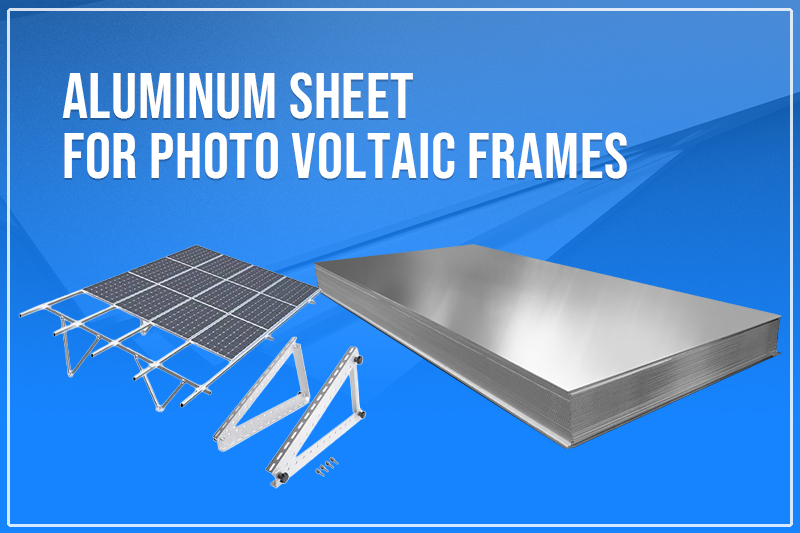
Photovoltaic modules are designed to operate outdoors for decades.
Wind, sand, rain, snow, and UV radiation are daily challenges.
The frame protects the panel edges, provides structural support, and secures installation.
The right selection of Aluminum Sheet for Photo voltaic Frames is foundational to long‑term reliability.
Among various aluminum alloys, 1100 H16 is gaining increased attention from PV frame manufacturers.
What exactly makes it stand out? Let’s break it down.
– Alloy 1100 – commercially pure aluminum (≥99.0% Al), not heat‑treatable.
– Temper H16 – work‑hardened to about 3/4 hard, giving higher strength and rigidity than O or H14.
– Key traits:
– Excellent electrical and thermal conductivity
– Strong resistance to atmospheric corrosion
– Good plasticity for cold forming
– Broad weldability
These characteristics match the real‑world needs of PV frames.
PV modules generate heat during operation. Poor heat removal lowers efficiency.
1100 aluminum has a thermal conductivity rating among the highest in the 1xxx series.
Frames made from this material help dissipate heat effectively, keeping panels in their optimal temperature window.
Frames are exposed to the elements year‑round – corrosion resistance is a top priority.
1100 aluminum naturally forms a dense oxide layer in the atmosphere. Its general corrosion resistance ranks among the best of all aluminum alloys.
This means that even without extra surface treatments, it performs well in typical outdoor environments.
(Mingtai Aluminum supplies bare coil/sheet and does not perform surface finishing.)
Aluminium weighs about one‑third as much as steel.
– Lower shipping costs
– Less labor for installation
– Reduced load on roofs or support structures
For both large ground‑mount farms and rooftop projects, the weight advantage adds value at every stage.
Frame production involves stamping, bending, cutting, and other cold‑working steps.
1100 aluminum offers good ductility, and the H16 temper still retains sufficient formability.
It also accepts multiple welding methods – TIG, MIG, resistance, and brazing – with excellent weld quality.
These two factors directly influence production efficiency and yield rates.
|
Aspect |
1100 |
3003 |
6061/6063 |
|
Strength level |
Meets standard frame needs |
Slightly higher |
Much higher (after heat treatment) |
|
Thermal conductivity |
Excellent |
Good |
Moderate |
|
Formability |
Easy |
Fairly easy |
Harder (especially T6) |
|
Overall cost |
Economical |
Moderate |
Higher |
> For the vast majority of standard PV frame applications, 1100 provides sufficient strength, while its advantages in thermal conductivity, formability, and cost are more pronounced.
Additionally, 1100 aluminum is infinitely recyclable – fully aligned with the solar industry’s commitment to clean energy and sustainability.
– Confirm the delivered temper is H16 – not O or H14 – as mechanical properties differ noticeably.
– Verify thickness tolerances against your frame design (common range: 0.3–6.0 mm).
– Inspect the sheet surface – it should be flat, free from waves, scratches, or oxidation stains.
– Request original mill test certificates and traceable inspection reports.
All things considered, 1100 H16 Aluminum Sheet for Photo voltaic Frames delivers excellent thermal conductivity, natural corrosion resistance, lightweight benefits, good formability and weldability, plus full recyclability – making it a balanced choice that combines performance and cost‑effectiveness for PV frame applications.
*Mingtai Aluminum supplies high‑quality 1100 H16 aluminum sheet in a full range of thicknesses and widths. Reach out to discuss specific PV frame material requirements.*
Q: What is the main difference between 1100 H16 and 1100 O for PV frames?
A: H16 offers higher strength and rigidity through work hardening, while O is fully soft with maximum formability but lower strength.
Q: Is surface treatment mandatory for 1100 H16 used in PV frames?
A: No – it depends on the specific environmental conditions; the bare material itself is already corrosion‑resistant for most outdoor sites.
Q: Can 1100 H16 be welded reliably for frame assembly?
A: Yes – it welds well with TIG, MIG, resistance, and brazing methods.
Q: What thickness of 1100 H16 is typically used for solar frames?
A: Common thicknesses range from 0.3 mm to 6.0 mm, depending on the frame design and load requirements.
Q: Is 1100 H16 aluminum sheet recyclable?
A: Yes – it is 100% recyclable indefinitely without any loss of quality.