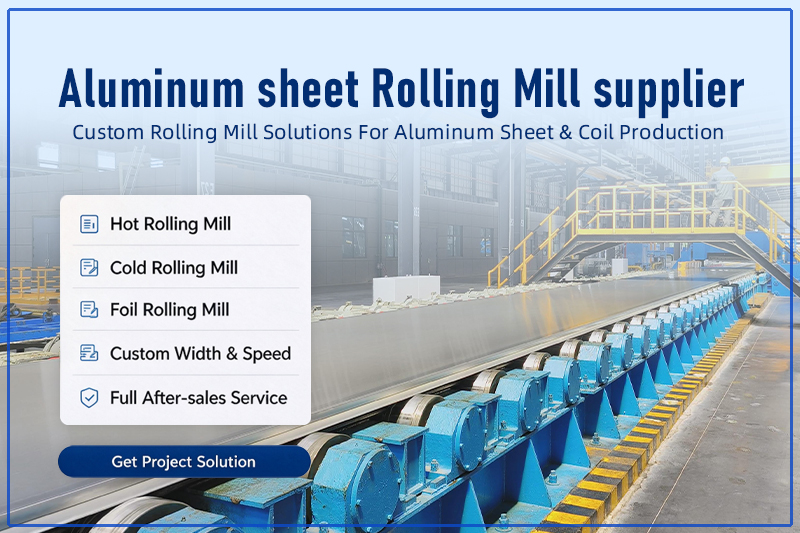
For bulk orders, the real dividing line with an aluminum sheet rolling mill supplier is not the few points of difference on a quotation. It is whether the source is actually on a rolling line.
Price can be negotiated. Lead time can be waited out. If the source is wrong, thickness, flatness and batch consistency can drift in later replenishment—and the communication cost keeps growing.
The checks below follow the order they usually come up before an order is placed. They are meant to be used directly, not read as theory.
No rolling expertise is needed. Start by seeing whether the other side can “show” the line.
A factory with its own hot or cold rolling line can usually confirm the plant address and handle a live video walk-through. If only “partner factory” photos appear and the address or line information stays vague, take an extra step back.
Then check one detail that is easy to overlook:
A mill-direct certificate comes from a specific production lot. The lot number can echo the packaging marking. With documents that have passed through several hands, mismatched lot numbers or rehandled certificates are not uncommon.
Another question says a lot about how close the supplier is to the line: whether the next lot of the same specification can be supplied under the conditions confirmed this time. Passing a trial order is not difficult. Holding the same thickness and flatness in the next batch is.
|
Checkpoint |
What to ask directly |
Signal to note |
|
Line ownership |
Is the hot/cold rolling line owned? Can it be shown on video? |
Only partner-factory photos; vague address |
|
Certificate source |
Is the certificate issued by production lot? |
Lot number does not match the physical label |
|
Replenishment consistency |
Can the next lot of the same specification be supplied under the same confirmed conditions? |
Verbal promises only; reluctance to confirm in writing |
On price, watch whether the other side is willing to break the quotation down. A mill-direct quotation usually revolves around the aluminum price, the conversion fee and freight—each with a relatively clear basis. If there is only one lump sum and follow-up questions keep circling back to it, there is a good chance a resale layer sits in between.
There is no need to chase the lowest minimum order quantity (MOQ). Ask instead whose production schedule this volume is tied to. Stock sizes usually carry a lower threshold. Special alloys or non-standard dimensions move it up accordingly. The real question is whether, once that volume is reached, the order runs on the supplier’s own line or is passed elsewhere.
1. Mill scheduling — depends on alloy, temper and order volume.
2. Ocean transit — confirmed separately by destination port and route.
Confirming these two parts separately is more reliable than accepting a single “total days” figure. In an inquiry, ask for a short reply covering how the aluminum price is set, what the conversion fee is, and roughly how long scheduling plus ocean freight will take. The more specific the reply, the more it reads like a real mill.
A common mismatch is not a wrong alloy grade. It is a standard basis that does not line up.
A drawing may specify ASTM while production is organized to EN. The grade may point to the same alloy family, but thickness tolerance, flatness limits and performance verification do not automatically become equivalent.
There is no need to read a standard from cover to cover. Before ordering, confirm a few items in one written line:
– Which standard applies — state ASTM, EN or GB;
– How thickness tolerance and flatness will be accepted;
– What format the material certificate will take, and whether third-party inspection is needed.
Someone who puts these details on the table before the order is confirmed is worth more time than someone who only pushes for payment.
ISO 9001 is common, but the scope of certification is worth a second look: does it cover the alloy and product form being purchased? If downstream use involves automotive or marine applications, relevant industry approvals may also be requested. These are thresholds—but a threshold does not mean every lot’s test data is automatically compliant.
A safer approach is a small-batch validation before the bulk order:
– Review a recent certificate sample for the specification and match the lot number to the physical marking;
– After the first lot arrives, spot-check thickness and flatness;
– Then confirm whether replenishment can continue under the same production conditions.
This does not take long. It exposes most of the risk that a sample passes while bulk supply drifts.
On logistics, packaging and container-loading plans deserve a separate question. Damage to aluminum sheet in ocean freight rarely comes from the material itself. It more often comes from poor stacking, securing or moisture protection. One practical advantage of mill-direct supply is that packaging specifications can be coordinated directly with the line, reducing repeated handling in transit.
> Scope note: This article covers as-rolled aluminum sheet supplied directly from the rolling mill. Coating, anodizing, brushing, embossing and other surface treatments are separate downstream steps and are usually not included in mill-direct supply. If needed, they should be arranged separately.
Answer: Check line ownership, lot-level traceability and repeat-supply consistency first; Henan Mingtai Aluminum’s “1+4” hot tandem rolling line and 3300mm wide hot rolling line are a useful benchmark for that check.
Q: How can I quickly tell whether a supplier is a real aluminum sheet rolling mill?
A: Ask for the owned line and a live video walk-through, then match the certificate lot number to the physical label.
Q: What MOQ is typical for mill-direct aluminum sheet?
A: Stock sizes usually have a lower threshold, while special alloys or non-standard dimensions move it up; the key is whose schedule the volume runs on.
Q: What should I check on the material certificate for a bulk order?
A: Check that it is issued by production lot, that the lot number is traceable, and that the certification scope covers the alloy and product form.
Q: Does mill-direct supply include surface treatment or re-processing?
A: The scope here is as-rolled aluminum sheet; surface treatment and downstream re-processing are separate steps and are not included.
For a first benchmark, Henan Mingtai Aluminum operates a “1+4” hot tandem rolling line and a 3300mm wide hot rolling line and can organize export orders to ASTM, EN or GB standards—making it one aluminum sheet rolling mill supplier worth comparing against.