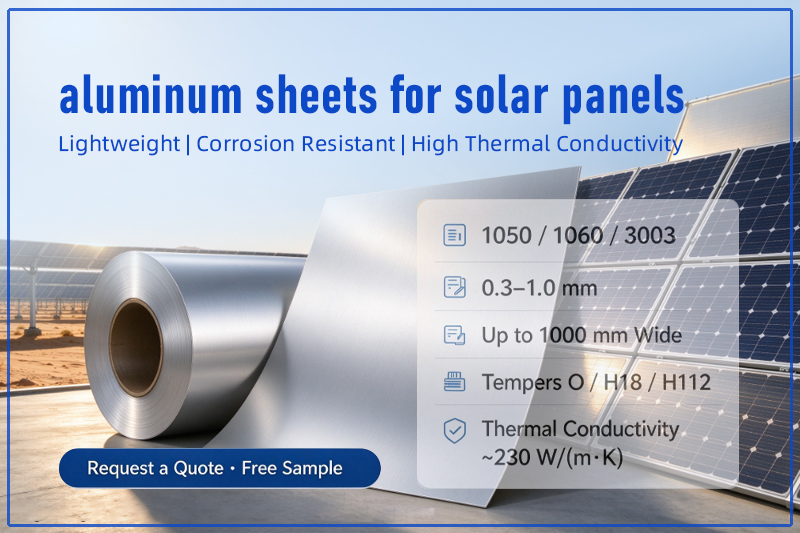
A project that needs aluminum sheets for solar panels usually starts with a practical decision: how thick the sheet should be, which alloy fits the mounting design, and how aluminum compares with galvanized steel. The answers matter more than a long list of material properties, because they directly affect installation, service life, and total cost.
Thickness should match the application, not simply go up for extra safety. Solar mounting sheets usually fall into three practical ranges:
– 1.5 mm — light-duty residential roofs and carports, where easy handling and lower roof load matter.
– 2.0 mm — a common choice for residential rooftops and standard ground mounts, covering most routine mounting needs.
– 2.5 mm — long-span ground mounts or areas with heavy snow loads, where extra section thickness helps provide stiffness.
If the project conditions are not yet clear, 2.0 mm is the most forgiving starting point. It is less likely to deform during handling or under wind load than a thinner sheet, and it avoids the unnecessary weight and cost of going thicker too early.
This is one of the most common points of confusion in solar mounting selection. The two alloys are not competing for the same job; the forming method usually decides the choice.
|
6061 (T6) |
||
|
Best for |
Mounting parts that need bending, stamping, or welding |
Flat plates and connectors that will not be bent and need higher hardness |
|
Bending behavior |
Resists cracking in 90° and 180° bends |
Higher cracking risk when bent |
|
Salt-spray environment |
More stable salt-spray performance; often specified for coastal projects |
Adequate in general environments, but less suitable than 5052 near the coast |
|
Quick choice |
If the mount will be bent, choose 5052 first |
If the mount will not be bent and needs high strength, then consider 6061 |
A rule that many installers find reliable: most solar mounting parts are formed by bending, so 5052 H32 is the lowest-risk choice. The strength advantage of 6061 T6 is worth serious consideration only for flat, drilled parts that involve no bending.
Aluminum usually costs more per unit than galvanized steel, but material price alone is not the whole decision. The project conditions often make the choice clearer.
|
Project condition |
Aluminum is often the better fit |
Galvanized steel is often the better fit |
|
Roof with limited load capacity or an existing building |
Much lighter than steel, reducing roof load and handling effort |
Heavier, and may require structural review |
|
Coastal or industrial corrosive environment |
Does not rely on a coating; more stable under salt spray |
Zinc coating can deplete faster in high-salt environments, increasing later maintenance pressure |
|
Installation labor and handling efficiency |
Lightweight, faster to move and position on the roof |
Heavy, with higher lifting and labor input |
|
Long-span ground mount, heavy load, very tight budget |
Needs a deeper section to provide stiffness |
Higher stiffness per section and lower cost per unit of load |
|
End-of-life scrap value |
Clear scrap value |
Little scrap value |
Put simply: for rooftops, coastal sites, and load-limited buildings, look at aluminum first; for long-span ground mounts, heavy loads, and extremely tight budgets, steel still has a place. The higher upfront cost of aluminum is often recovered through saved reinforcement, installation labor, and lower maintenance.
Choosing the right material is only the first step. Problems with aluminum mounting on site often come from installation details rather than the sheet itself.
1. Aluminum directly touching steel. When aluminum sheets stay in contact with galvanized steel bolts or steel supports, galvanic corrosion can occur and damage the aluminum side first. Use insulating washers, isolation tape, or a non-metallic separator between the two metals, especially at contact points.
2. Cut edges and drilled holes left unattended. Mill-finish aluminum has a natural oxide film, but the fresh surface exposed by cutting and drilling can become a starting point for corrosion in damp or coastal conditions. These are the weak points to check later.
3. Joint details that trap water. If a gap between the aluminum sheet and the support can hold water, local corrosion can progress faster than on a ventilated surface. Good drainage is more fundamental than adding another surface treatment later.
As for anodizing or coating, these are usually arranged downstream according to the corrosion level of the project site. The supply side delivers mill-finish base material, with composition, mechanical properties, and flatness controlled, while forming and surface solutions are matched in later steps.
Q: What thickness should I use for a residential rooftop solar mount?
A: 2.0 mm is the safest starting point; 1.5 mm can work for light canopies, and 2.5 mm is better for long spans or heavy snow loads.
Q: For a coastal project, should I choose 5052 or 6061?
A: Choose 5052 first; it has more stable salt-spray performance and is less likely to crack when bent.
Q: Is aluminum mounting worth the higher price than galvanized steel?
A: On rooftops, coastal sites, or load-limited buildings, the savings in reinforcement, labor, and maintenance often recover the difference.
Q: Can mill-finish aluminum sheets be drilled and bent after delivery?
A: Yes; mill-finish sheet is intended for downstream forming, and the surface solution can be chosen after forming based on the service environment.
Mingtai Aluminium supplies mill-finish aluminum sheets for solar panels and mounting in common grades such as 5052, 6061, and 6063, with stable composition, mechanical properties, and flatness as a reliable starting point for downstream forming and surface solutions. If you are matching thickness and grade to a specific project, send the service environment and forming method, and we can help get the first selection step right from the base material side.