In today’s automotive industry, lightweighting is key. Aluminum alloys are at the forefront of this shift. Among them, auto grade aluminum plate 5182 and 5754 stand out as two of the most popular choices for body panels and structural components. This guide will compare these two alloys in detail. Our goal is to help you select the right material for your specific application.
The 5xxx series alloys use magnesium as the main element. This gives them a perfect blend of properties for cars:
Excellent Formability: They can be stamped into complex shapes.
Good Corrosion Resistance: They perform well in harsh, wet environments.
Medium-to-High Strength: They allow for thinner parts without sacrificing safety.
Great Weldability: They work with various modern joining techniques.
These traits make 5182 and 5754 ideal for vehicle bodies, closures, and inner structures.
|
Feature |
||
|
Key Trait |
“Deep Drawing Specialist” – Superior formability |
“All-Rounder” – Balanced strength, formability, and corrosion resistance |
|
Main Advantage |
Very high elongation, ideal for complex deep draws |
Higher medium strength, better corrosion resistance |
|
Typical Tensile Strength |
~260-320 MPa |
~240-280 MPa |
|
Typical Yield Strength |
~130-180 MPa |
~120-160 MPa |
|
Elongation |
Very High (Typically ≥20%) |
High (Typically ≥15%) |
|
Best For |
Parts with very complex, deep-drawn geometries |
Parts needing a balance of strength, formability, and corrosion resistance |
Choose 5182 for parts that require deep drawing or have complex curves. Its high plasticity greatly reduces the risk of cracking during stamping. This improves production yield.
Typical Uses: Car door inner panels, hood inners, trunk lid inners.
Choose 5754 for parts that need a mix of structural strength, good formability, and strong corrosion resistance. It performs well after welding.
Typical Uses: Body frame structures, chassis parts, seat rails, truck bodies, fuel system components.
Selecting 5182 or 5754 is just the first step. A material that works in prototyping can fail in mass production. Issues like varying stamping quality or inconsistent welds can arise. Often, the problem is not the alloy choice itself. It is the lack of batch-to-batch consistency and precise dimensional control.
Consistency Enables Mass Production: Automated auto lines require that every coil of aluminum performs the same. Mechanical properties must have minimal batch-to-batch variation. This depends on the manufacturer’s strict process control from casting to rolling.
Tolerances Affect Precision: Parameters like thickness tolerance and flatness are critical. They impact part accuracy, assembly fit, and robotic welding stability. Tight tolerances are a must for high-quality plate.
* Traceability Ensures Reliability: Certification to the IATF 16949 standard and a full traceability system are essential. They provide a material “ID card.” If an issue occurs, the root cause can be found and fixed quickly. This protects your production line from costly downtime.
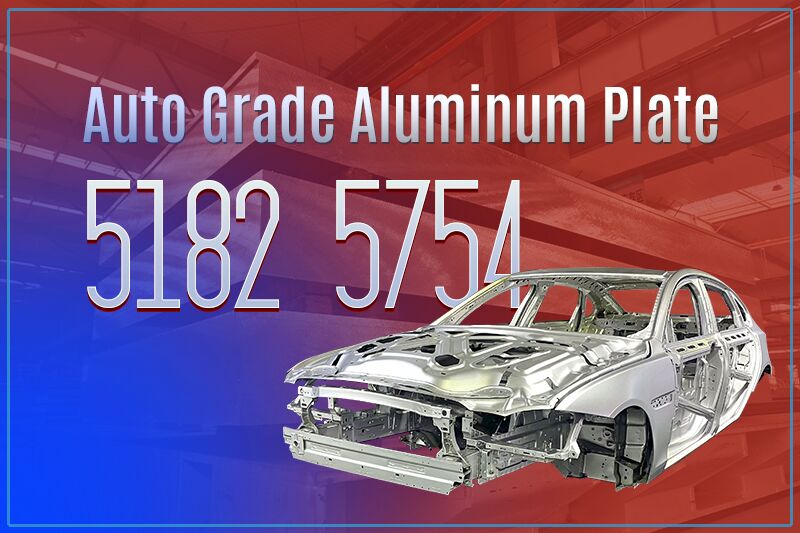
At Mingtai Aluminum, we understand the auto industry’s need for reliable materials. We supply 5182 and 5754 plates that meet global standards like ASTM and EN. More importantly, we ensure reliability through strict process control and a certified IATF 16949 quality system. We focus on providing consistent, traceable auto grade aluminum plate 5182 5754 to support your long-term success in lightweighting.
Need a reliable partner for your next automotive project? Mingtai Aluminum delivers high-performance, consistent 5182 and 5754 aluminum plates. Let our expertise support your production success.
Q1: Which alloy, 5182 or 5754, is better for new energy vehicle battery enclosures?
A: 5754 is typically the preferred choice due to its better balance of strength, formability, and corrosion resistance, which are critical for battery enclosure performance.
Q2: How can I get a Technical Data Sheet (TDS) or sample from Mingtai Aluminum?
A: Contact our sales team with your specific requirements (alloy, temper, thickness). We will provide the relevant TDS and can arrange sample materials.
Q3: Do your materials come with full third-party test reports?
A: Yes. We provide authoritative third-party test reports with shipments, ensuring data transparency and compliance with automotive industry standards.