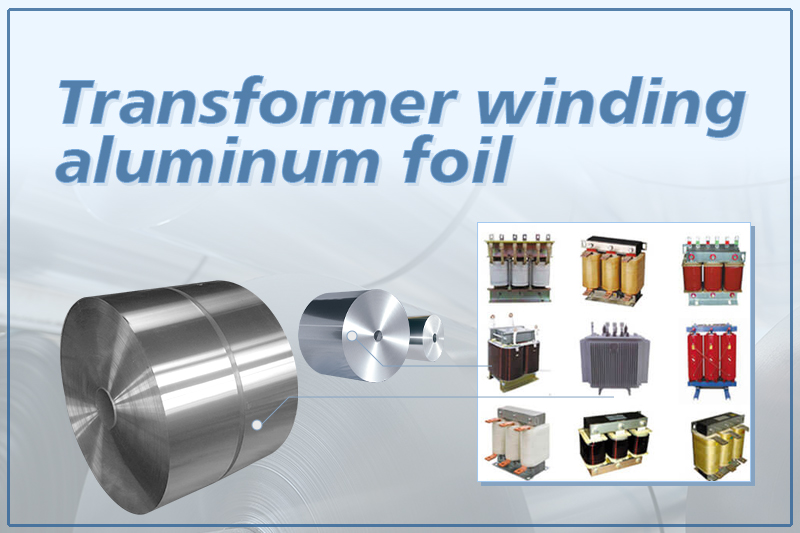
1060-O aluminum foil is a familiar material in dry-type and distribution transformer windings. What really determines whether a coil runs smoothly on the winding machine and whether the insulation remains reliable afterward is often not the grade name, but whether the specification fits, the edge condition, and batch-to-batch consistency. In other words, choosing transformer winding aluminum foil is less about picking an alloy and more about getting the details right on the line.
Price comparison is tempting at the selection stage, but within the same grade, the real difference lies in whether edge control, thickness consistency, and delivery stability are clearly stated and written into the specification.
It is not a special alloy. It is a balanced basic option among conductivity, formability, and cost. For most low- and medium-voltage dry-type and distribution transformer windings, that balance is exactly what is needed.
– Suitable for: conventional distribution transformers, dry-type low-voltage windings, and designs that value material cost and winding efficiency.
– Consider a higher-purity grade: for stricter loss requirements and higher currents.
– Do not look at the grade alone: within the same grade, edge control and thickness consistency are the real sources of incoming differences.
Unstable thickness affects winding resistance and heat dissipation. A nominal thickness alone is not enough at the quotation stage; check whether the whole coil is stable across its width. Consistency at different positions in the same coil says more than a single-point measurement.
The wrong width leads to winding misalignment and edge trim waste. Custom width is not an add-on service; it is the starting point for reducing downstream trouble.
Oil residue or contaminants that show up after winding cost far more to trace than to control at incoming inspection. This winding foil is usually supplied in mill finish, without surface modification or coating; cleanliness should be a separate acceptance item.
Wire conductors have a round cross-section; foil is a thin strip with edges. As the foil passes through tension devices, insulation paper, and tooling, a burr that is hard to see may scratch the interlayer insulation paper during high-speed operation.
> For foil-wound transformers, edge quality is not a cosmetic item; it is an insulation issue.
– Deburring: treating a sharp edge so that it no longer poses a scratch risk.
– Rounded edge: making the edge smoother for designs with stricter insulation requirements.
In most standard foil windings, a well-controlled deburred edge is enough to protect interlayer insulation; whether to specify a rounded edge should be written into the specification, not replaced by vague words such as “smooth edge.”
|
Scenario |
Direction worth considering |
|
Low- and medium-voltage dry-type and distribution transformer windings |
1060-O foil winding offers a balance of cost, weight, and short-circuit behavior |
|
Very limited space or tight loss targets |
Copper wire winding still has a place in wire diameter flexibility and process maturity |
|
Batch winding with a focus on process efficiency |
Foil winding has a shorter process flow and suits stable scheduling |
One sentence: Do not choose the wrong structure just to be “cheaper”; look at where the winding design is actually constrained.
Scheduling in transformer manufacturing is tightening, and reliable delivery of winding materials is no longer just a bonus. More important than “the fastest few days” is how well standard sizes are covered, how long custom width takes, and whether conductivity and thickness tolerance are stable from batch to batch.
Stock covering common widths reduces time spent waiting for slitting; batch stability determines whether the winding process needs repeated adjustment. Even a slight shift in foil performance may not be visible on the nameplate, but it leaves a trace in temperature rise and long-term loss.
– Check measured conductivity: do not accept only a general statement of “meets standard.”
– Quantify edge condition: write burr height and edge profile type into the specification.
– Measure thickness across the width: focus on whole-coil stability, not just a center-point value.
– Control cleanliness at incoming inspection: do not wait until after winding to judge oil residue or contaminants.
– Check whether coil weight and packaging are convenient for on-site lifting and use.
Q: How do 1060-O and 1070-O compare for transformer windings?
A: 1070 offers slightly higher purity and conductivity for stricter loss targets, while 1060-O covers most distribution and general dry-type windings at lower material cost.
Q: Is a deburred edge enough, or should I specify a rounded edge?
A: A deburred edge protects interlayer insulation in most standard foil windings; specify a rounded edge only for stricter insulation designs.
Q: What should I check first on incoming foil?
A: Check edge condition first, because burrs are the most direct and least visible risk to foil winding insulation.
Mingtai Al supplies transformer winding aluminum foil in 1060 with a mill finish, without surface modification or coating. Specifications can be matched to the winding design, and samples are available for comparison.