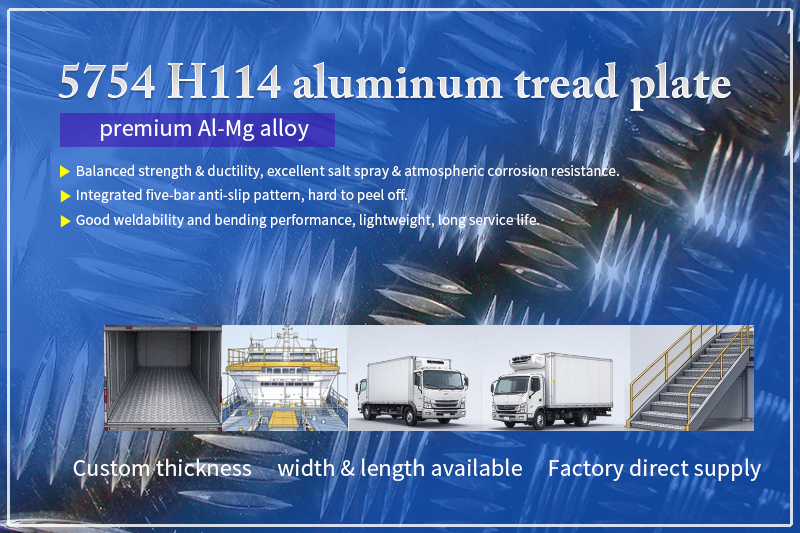
Workshop floors are not showroom floors. Oil, coolant, wash water, metal chips, rubber wheels and constant foot traffic create very specific failure modes: rust-through, denting, cracked welds, and a surface that becomes more slippery after cleaning. The 5754 H114 aluminum tread plate deserves consideration here because it balances corrosion resistance, strength, weldability and on-site fabrication without an obvious weakness.
Five-bar tread works in a straightforward way: raised bars create channels for water and oil underfoot, while the raised geometry provides grip. In wet or oily conditions, this is more stable than a smooth plate.
– The pattern and the base plate are rolled as one piece, not applied or sprayed on later;
– Forklift traffic, scraping and brushing will not lead to the “coating worn off, now it slips” problem;
– Slip resistance comes from the plate shape itself, not from surface treatment.
> The real risk on a workshop floor is not “no slip resistance at the start,” but “the slip-resistant layer is gone over time.”
Outdoor corrosion is easy to see. Inside a workshop, corrosion often hides under cleaning-agent residue, pooled coolant and oil-water mixtures. 5754 is an Al-Mg alloy with good resistance to industrial atmospheres, damp conditions and many neutral cleaning media. The natural oxide layer provides ongoing protection without relying on paint or an extra coating.
One boundary should be stated clearly: if the floor is in continuous direct contact with strong acids or strong alkalis, no Al-Mg alloy can replace a targeted anti-corrosion solution. Chemical exposure beyond neutral cleaning should be assessed separately and not assumed to be within the capability of the Al-Mg alloy.
The load capacity of tread plate cannot be judged by thickness alone. These factors matter more for real-world performance:
1. The spacing of the steel supports or concrete base below;
2. Whether the load is uniformly distributed or applied as point loads from forklift wheels or equipment legs;
3. Whether the wheels are rubber tires or small-diameter hard wheels.
The height of the tread pattern is usually not counted as base-plate thickness in structural calculations, so base-plate thickness is the figure to use when reading specifications. For normal walkways and light hand-cart areas, a medium-thickness five-bar plate can perform well with reasonable support spacing. In areas with solid-tire forklifts or frequent heavy loads, reduce the support spacing first and compare thicker specifications, rather than simply changing to a thicker plate under the same support conditions.
The weldability of 5754 is a practical advantage in workshop flooring. Gas welding, arc welding and resistance welding are all workable, and cold forming makes cutting, drilling and bending and edge folding straightforward on site without special annealing or preheating.
– Welded fixing: suitable for steel platforms and continuous traffic areas, for a continuous, integrated surface;
– Mechanical fixing: suitable where local removal is needed, services run below, or a concrete base is not suitable for welding.
Leave expansion gaps during installation, keep fasteners flush or countersunk with the plate surface, and deburr cut edges. These details matter more for long-term safety and maintenance than paying for a more expensive plate.
Maintenance of a rolled surface is simple: neutral cleaner, soft tools and timely rinsing. For oily areas, soak with a neutral detergent and wipe lightly; avoid steel wool and strong acids or alkalis, and rinse so no chemical residue remains.
Because the surface has no organic coating or conversion film to “maintain,” there is no coating wear followed by re-coating. The flip side is that the surface condition will reflect the service environment and cleaning method. The supply scope is rolled tread plate, with no surface treatment or re-processing of coil; any additional coating belongs to downstream operations.
– 3003 tread plate: low cost and adequate for dry or lightly damp pedestrian areas; expected life drops in welded structures and long-term wet conditions.
– 5052 tread plate: also Al-Mg, with good corrosion resistance and a similar position to 5754; a reasonable candidate for bolted fixing and cost-sensitive projects.
– 6061-T6 tread plate: higher strength for heavy loads and frequent forklift traffic, but with higher cost and welding threshold, and not always the most economical choice for large-area flooring.
– 5754 H114: in workshop floors that need welding, corrosion resistance, moderate rather than extreme loads, and straightforward on-site fabrication, it does not sacrifice one of those needs for another.
Q: Can this plate be used directly for forklift aisles?
A: It depends on plate thickness, support spacing and wheel type, and solid or small hard wheels should be checked as point loads.
Q: How should 5754 and 5052 be compared for workshop floors?
A: Both have similar corrosion resistance; choose 5754 when the floor is welded into a structure, and 5052 when bolted fixing and cost sensitivity dominate.
Q: How is thickness selected for workshop flooring?
A: Determine support spacing and load type first, then select by base-plate thickness rather than overall tread height.
Q: Can 5754 H114 be welded on site?
A: Yes, gas, arc and resistance welding are all workable, and cutting, drilling and bending and edge folding are straightforward on site.
Q: Will the five-bar slip resistance wear away?
A: It does not rely on an added coating; the pattern and base plate are rolled as one piece, so the metal structure continues to provide grip.
Q: Is extra coating or surface treatment supplied?
A: The supply is rolled tread plate without surface treatment or re-processing of coil, and extra coating is handled downstream.
The supply scope is rolled plate, with no surface treatment or re-processing of coil; any additional coating is handled downstream. For projects that need a stable, traceable substrate, Mingtai Al supplies 5754 H114 aluminum tread plate in the rolled state and can quote by thickness, width and pattern type.