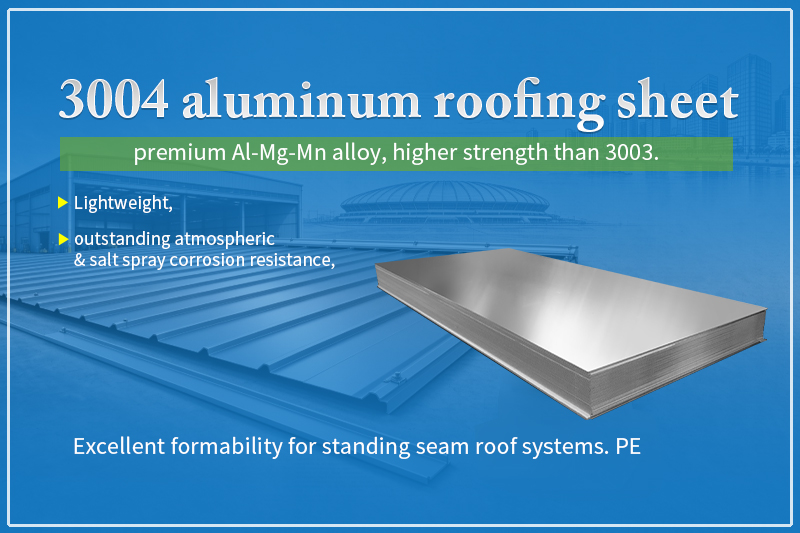
A leaking aluminum roof is rarely caused by the wrong alloy grade alone. More often, fasteners do not match the aluminum panel, long panels have no room to move with temperature changes, or the coating is scratched during installation and not treated in time. A 3004 aluminum roofing sheet gives the roof a stronger base, but a roof is a system, and the base metal is only the starting point. The sections below cover alloy choice, weather resistance, forming, and installation in plain language, so the judgments are useful in practice.
3004 and 3003 belong to the same aluminum-manganese family. The difference is that 3004 adds magnesium. At the same thickness, 3004 handles wind load, snow load, or wider purlin spacing with less deformation. It is slightly harder than 3003, but normal bending, roll forming, and punching still work well.
3105 is also common in roofing. It offers adequate strength, good formability, and strong coating compatibility. If the profile is standard, the span is short, and budget comes first, 3003 or 3105 can be a sensible starting point. When the project needs thinner gauge, or the roof must face higher wind and snow loads, the extra strength of 3004 starts to matter.
|
Comparison |
3004 |
3003 |
3105 |
|
Strength and load bearing |
Higher; suits thinner gauge or larger loads |
Basic level; suits standard short spans |
Medium; balanced |
|
Forming behavior |
Normal bending and roll forming are workable |
Softer and easier to form |
Good, with strong coating compatibility |
|
Typical trade-off |
Wind, snow, or weight-saving needs come first |
Budget and standard profiles come first |
Standard profiles with overall balance |
Yes—when coating, fasteners, and installation are matched, a 3004 aluminum roofing sheet from Henan Mingtai Al can perform reliably in coastal and industrial conditions.
Long-term exposure studies of aluminum-clad 3004 roofing material show that the protective aluminum layer kept protecting the base alloy in coastal-urban and industrial climates. That gives 3004 a solid corrosion-resistance base.
It does not work everywhere without conditions. General outdoor atmosphere, rain, and most industrial environments are comfortable for 3004. If the roof is exposed to high ammonia levels, such as in livestock buildings, or to strong acid or alkaline mist and chemical deposits, bare metal can reach its limits. Those cases need extra protection at the system level.
If the final project needs a colored surface, base metal and painting are two separate steps. Mingtai Al supplies 3004 base metal but does not perform surface treatment or downstream re-processing of aluminum sheet, coil, or foil. Coating selection and painting are handled by specialized downstream operations.
In 3004 roofing, H24 is the most commonly specified hardness state, or temper. It balances stiffness and ductility well for roll forming and field cutting. For curved or large-radius profiles, H22 is softer and easier to fit to the curve. For flashings, details, and areas that need dent resistance, H16 or H18 can be used, but the forming window is narrower and demands more from equipment and operation.
> A useful rule: if the order says only “3004” and does not specify temper, the supplier may ship the default state, and the problem may only appear at the roll-forming line. The more complex the profile and the tighter the curve, the more important it is to confirm temper before alloy grade.
– Thickness: There is no single figure for every roof, but thickness must be checked together with purlin spacing, fastening method, and local wind load. Chasing a thinner gauge to save material can push the saved cost into wind-uplift or dent-resistance problems later.
– Width and length: Coil or cut-to-length sheet is available. Width should be worked backward from the finished width of the target profile, not chosen as a “standard width” first and then forced to fit the profile.
– Price logic: The price consists of aluminum ingot price plus processing fee, and the ingot price moves daily. Comparing only a total price without confirming alloy, temper, thickness tolerance, and surface condition does not give a like-for-like comparison.
1. Letting carbon steel or galvanized fasteners touch the aluminum directly. Aluminum is more active than steel. Each steel screw contact point can create a small battery-like corrosion point under wet conditions, and the aluminum around the hole corrodes first. Roofing fasteners should be stainless steel or aluminum, used with isolating washers to separate the two metals.
2. Fixing every screw on a long panel too tightly. Aluminum expands and contracts more than steel, so a long roof panel moves noticeably with temperature changes. If the middle of the panel is fixed too tightly, that movement has nowhere to go, holes elongate, and in severe cases the panel can tear. Long panels usually need sliding clips or concealed fixing systems to absorb movement.
Mingtai Al supplies 3004 base metal in multiple coil and sheet specifications for roofing, with stable substrate performance suitable for downstream roll forming. To confirm alloy, temper, and size fit for a specific panel profile and service environment, share the project details for a direct review.
Q: When is the higher cost of 3004 over 3003 justified?
A: It is justified when the project needs thinner gauge, longer spans, or higher wind and snow loads; for standard short-span panels with budget priority, 3003 remains a reasonable baseline.
Q: How long does 3004 aluminum roofing last in coastal areas?
A: Long-term studies show aluminum-clad 3004 roofing has a sustained protection record in coastal-urban climates, but actual life depends on coating, fasteners, and installation details.
Q: Does Mingtai Al provide color coating or roll forming for 3004 roofing panels?
A: No—Mingtai Al supplies 3004 base metal only and does not perform surface treatment or downstream re-processing; coating and roll forming are handled by specialized downstream operations.