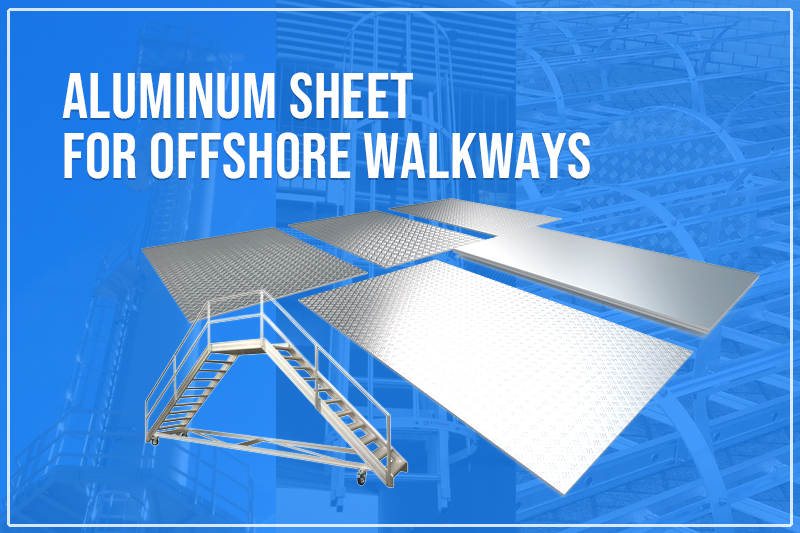
Selecting the right aluminum sheet for offshore walkways is a critical decision. These pathways endure constant salt spray, moisture, wave impact, and temperature swings day after day. Choose poorly, and corrosion, cracking, or premature replacement become inevitable within just a few years. The real question is: which material can stand up to this environment without coatings or frequent maintenance—and still remain reliable for decades?
The answer points to one well‑proven alloy grade: 5083‑H111.
Material selection for offshore walkways goes beyond simple strength. You need a balance of corrosion resistance, light weight, weldability, and formability.
5083 is an Al‑Mg alloy (5xxx series) with magnesium content between 4.0% and 4.9%. This gives it excellent resistance to seawater and marine atmospheres.
– Compared with 5052 – 5083 offers higher strength, providing more margin for foot traffic and light loads.
– Compared with 6061 – 5083 loses much less strength in the weld heat‑affected zone, which is vital for structures requiring extensive welding.
– Compared with steel – 5083 weighs about one‑third as much, reducing transport and installation costs and placing less load on platform foundations.
These properties make 5083 the natural first choice for this application.
The temper designation often confuses buyers. H111 means the material has received a small amount of work hardening after final annealing, but still retains good ductility.
In practice, this offers three clear benefits:
– Enough strength – It meets all typical loading requirements for walkways without over‑engineering.
– Easy to form – Good elongation allows bending, rolling, and stamping of tread patterns without cracking.
– Weld‑friendly – As a non‑heat‑treatable alloy, it requires no complex post‑weld heat treatment, simplifying on‑site fabrication.
Compared with H116 (higher strength and better exfoliation resistance), H111 trades a little strength for better formability. Compared with H321, it is more suitable for curved components. For tread plate walkways, H111 is the balanced choice between performance and workability.
Marine environments attack metal around the clock—persistent salt fog, splashing waves, and wet‑dry cycles from tides. What makes 5083 capable of surviving this without any protective coating?
Two layers of defence work together:
– Natural oxide film – Aluminium instantly forms a dense, self‑repairing aluminium oxide layer on its surface. This alone is a powerful barrier.
– Alloy chemistry – The high magnesium content stabilises that oxide film, making it more resistant to chloride penetration. Copper is kept very low because even small amounts of copper reduce seawater corrosion resistance.
This inherent protection means no regular derusting, repainting, or patching is required. Over the full service life, the maintenance savings are substantial—and this is exactly why a quality aluminum sheet for offshore walkways does not rely on any applied coating.
Wet, oily, or algae‑covered walkways are a major safety hazard. Slip resistance is non‑negotiable.
5083 aluminium can be rolled directly into tread plate (checker plate) with patterns like diamond, five‑bar, or lentil. These raised shapes provide extra grip between shoe soles and the surface. More importantly:
– The pattern is integral to the plate—it will never peel off or wear away.
– The raised ribs also increase stiffness, so a thinner plate can carry the same load.
– No need for anti‑slip tapes or coatings that degrade over time.
For offshore walkways, tread plate offers a proven combination of safety, durability, and low upkeep.
Even with the right grade, a few critical steps remain. Offshore projects demand strict compliance, so we recommend running through this list before finalising any purchase:
1. Check class society approvals – Confirm that the material carries type‑approval certificates from major societies such as CCS, ABS, BV, LR, or KR. This is not just a regulatory hurdle—it is a mark of quality.
2. Define exact dimensions – Specify thickness (typically 3–6 mm for walkways), width, length, and the desired tread pattern.
3. Request mill test certificates – Each delivery should include a full MTC (Mill Test Certificate) covering chemical composition, tensile strength, yield strength, and elongation.
4. Confirm the temper – Make sure the certification states H111, not H112 or H116, to avoid mismatched properties.
When you source an aluminum sheet for offshore walkways, always ask for these documents upfront—they save costly surprises later.
Q: Does 5083‑H111 need a surface coating for offshore use?
No, its natural oxide film provides adequate corrosion protection without any added coating.
Q: Which is better for walkways—H111 or H116?
H116 is stronger, but H111 is easier to form, making it the more balanced option for tread plate walkways.
Q: Will the slip‑resistant pattern wear out over time?
No, the pattern is rolled integrally with the plate and lasts as long as the material itself.
Q: Does 5083 become brittle in cold climates?
No, it retains excellent impact toughness even at very low temperatures, suitable for Arctic or LNG environments.
Mingtai Aluminum Industry supplies 5083‑H111 sheets with full class society certifications and flexible specifications. We are ready to provide technical datasheets and project‑specific guidance.