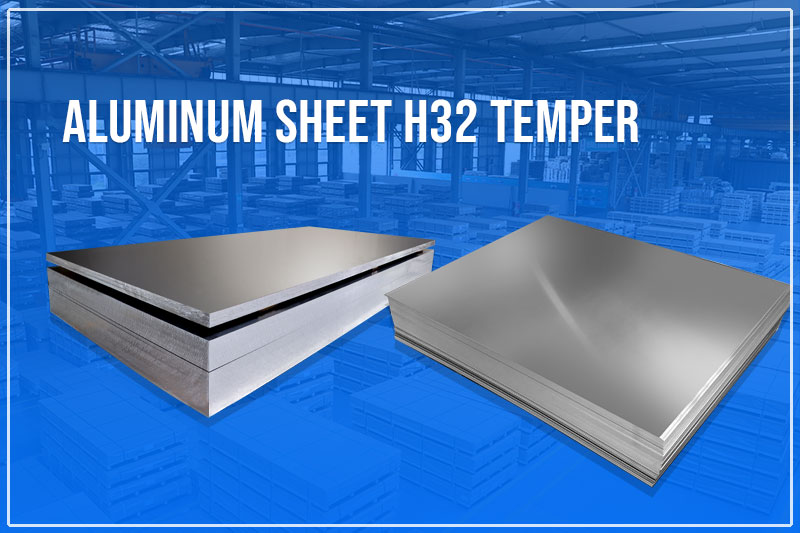
The “H” in H32 stands for strain‑hardened (cold‑worked). The “3” indicates that the sheet has been stabilized by a low‑temperature heat treatment after cold working, which removes internal stresses and locks in stable properties. The “2” denotes a hardening level of quarter‑hard.
In simple terms: the sheet is cold‑rolled to increase strength, then lightly heat‑treated to improve stability. The result is a material significantly stronger than the annealed (O) temper, while still retaining good formability.
5052 is an Al‑Mg alloy with a magnesium content of roughly 2.2–2.8% and no copper. The absence of copper is key—it gives this alloy excellent corrosion resistance, far superior to many other aluminium series.
Typical data from industry standards (ASTM B209) for 5052-H32 include:
– Ultimate tensile strength: ~228 MPa (33 ksi)
– Yield strength: ~193 MPa (28 ksi)
– Elongation: ~12%
– Brinell hardness: ~60 HB
– Elastic modulus: ~70 GPa
– Density: 2.68 g/cm³
What do these numbers mean in practice? The strength is much higher than pure aluminium (1xxx) or 3003 alloy, yet it is not so hard that it becomes difficult to bend or stamp.
Corrosion resistance is one of the standout features. 5052-H32 performs exceptionally well against seawater, marine atmospheres, and industrial environments—hence its common nickname “marine grade.” It also offers good fatigue strength, making it suitable for components subjected to cyclic loads.
Weldability is excellent. TIG, MIG, and resistance welding all work well, and weld strength typically reaches over 90% of the base metal. Cold formability is good—90° bends are usually crack‑free, with a recommended minimum bend radius of 0.5 to 1 times the sheet thickness.
Because of its well‑balanced properties, 5052-H32 is used in a surprisingly broad range of sectors:
– Marine & Offshore – hulls, decks, bulkheads, and interior fittings. Seawater resistance is the primary driver.
– Transportation – automotive body panels, fuel tanks, bus luggage racks, truck components, and trailer siding. Lightweight and structural strength work together.
– Electronics & Enclosures – server racks, instrument cases, heatsinks, and appliance panels. Good formability allows complex stamping.
– Building & Architecture – curtain walls, ceiling panels, signage, and interior decorative sheets.
– Pressure Vessels & Chemical Equipment – LNG storage tanks, chemical containers, and cryogenic vessels.
It also appears in aerospace applications such as fuel tanks and fluid lines.
This is one of the most common questions for purchasers.
H32 vs. O (Annealed)
– O temper is the softest state, with very high elongation—ideal for deep drawing or complex forming. But strength is minimal.
– H32 offers much higher strength while retaining good formability. Choose O for severe deformation, H32 when structural integrity matters.
H32 vs. H34
Both are strain‑hardened and stabilized, but H34 is half‑hard (more cold work).
– H34 has higher strength (UTS ~260 MPa, hardness ~68 HB) but slightly lower formability.
– H32 bends more easily and is more forgiving in stamping operations.
– Rule of thumb: pick H32 if you need more forming; pick H34 if strength is the top priority and forming is limited.
5052-H32 sheets are typically supplied according to ASTM B209. Thicknesses range from very thin foil to heavy plate. The standard surface is mill finish (no protective film), so minor scratches from handling or shearing are normal and acceptable for most applications.
When sourcing, pay attention to three things:
– Mill Test Certificates (MTC) – ensure full traceability.
– Batch‑to‑batch consistency – especially for mechanical properties and chemistry.
– Supplier process maturity – large mills with stable production lines usually deliver more reliable quality.
Q: Which is better, H32 or H34?
A: It depends—choose H32 if you need more formability, H34 if you prioritise higher strength.
Q: Can 5052-H32 be welded?
A: Yes, it welds well with TIG, MIG, and resistance methods, with weld strength above 90% of the base metal.
Q: Is H32 aluminium sheet resistant to seawater?
A: Very much so—it is a preferred material for marine and offshore applications.
Q: What is the minimum bend radius for H32?
A: Generally 0.5 to 1 times the sheet thickness for a 90° bend without cracking.
Q: How does 5052-H32 compare with 6061-T6?
A: 5052 has far better seawater corrosion resistance, while 6061 is stronger and takes anodising better.
Q: Can H32 sheet be painted or anodised?
A: Yes, the mill finish surface accepts painting and anodising well.
As a large‑scale aluminium sheet producer, Mingtai Aluminum offers reliable supply of aluminum sheet h32 temper in full compliance with ASTM B209, with consistent quality and a wide range of thicknesses. Contact us for your specific requirements.