When comparing Anodizing vs. Mill Finish for aluminum, you’re really looking at two completely different surface conditions. One is raw aluminum straight from the rolling mill. The other is a hardened, man-made oxide layer. This choice affects how your material looks, how long it lasts outdoors, and whether you can still weld or bend it easily. No complex chemistry – just practical facts to help you decide.
Mill finish aluminum is exactly what comes out of the hot or cold rolling mill. It has no extra surface treatment. The surface may show rolling marks, light oil residue, or even tiny scratches and oxide spots. It’s not perfectly uniform.
Key characteristics of Mill Finish:
– Uneven appearance – gloss and color can vary across the same sheet
– Soft surface – a key or fingernail can leave a visible mark
– Relies on a natural oxide layer (only 0.01–0.1 micron thick). Fine for dry indoor use, but in humid or salty air, white spots and pitting can appear within months
– Lowest cost – good for interior parts, temporary protection, or as a base for painting, laminating, or welding
Think of it as unfinished concrete floor – usable, but not refined or durable for long.
Anodizing is not plating and not paint. The aluminum part is placed in an electrolytic bath, and an electric current makes the surface grow a dense, hard aluminum oxide layer. This layer is part of the metal itself – it won’t peel or flake. By controlling the current, time, and bath chemistry, you can achieve thickness from 5 to 30 microns. You can also dye it black, gold, champagne, or other colors.
Advantages of anodized aluminum:
– Very hard – close to sapphire. Everyday use rarely scratches it
– Excellent corrosion resistance – passes hundreds of hours of salt spray tests. Lasts 10+ years in coastal or industrial areas
– Uniform look and fingerprint resistant – smudges wipe off easily
– Color built-in – no paint to chip later
But there are trade-offs. Cost is 30%–100% higher than mill finish. The oxide layer insulates electricity, so you cannot weld directly on it. Bending or stamping thick anodized layers (over 15 microns) can cause cracks – forming should be done before anodizing.
Think of anodizing as armor plus a luxury finish – looks great and tough, but don’t try to modify it afterward.
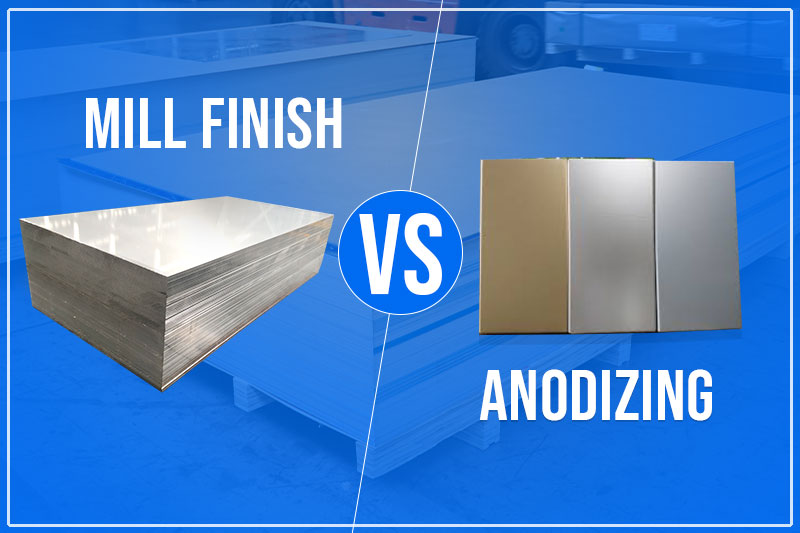
– Appearance: Mill finish looks uneven, like raw industrial metal. Anodized looks uniform and smooth, like a phone case.
– Scratch resistance: A key easily marks mill finish. Anodized shrugs off most scrapes.
– Corrosion resistance: Mill finish may show pitting outdoors within 2–3 years. Anodized lasts a decade or more in harsh environments.
– Fabrication ease: Mill finish can be welded, bent, punched, or drilled without trouble. Anodized should be left alone – any heavy fabrication will damage the layer.
– Unit cost: Mill finish is cheaper. Anodized costs more upfront but saves on replacement and maintenance.
Step 1: Do you need heavy secondary processing?
If you plan to weld, deep‑bend, punch holes, or tap threads after receiving the aluminum, choose mill finish. Anodizing first will crack, burn, or fail in those areas.
Step 2: Indoor or outdoor use?
Dry indoor areas like equipment interiors or support beams behind a ceiling – mill finish works fine. But for outdoor facades, railings, windows, signs, or any coastal/chemical plant environment – anodizing is required, preferably with a 15+ micron coating.
Step 3: How important is surface quality?
If your client demands “no rolling marks,” “no oil stains,” or “fingerprint resistance,” mill finish cannot meet these. Those specifications are exactly why anodizing exists.
Misunderstanding 1: “Mill finish has no oxide layer, that’s why it corrodes.”
Fact: It does have a natural oxide layer, but only 0.01 microns thick – almost no protective value.
Misunderstanding 2: “Anodized aluminum fades because it’s poor quality.”
Fact: Properly sealed anodizing does not peel or flake. However, cheap dye or poor UV sealing can cause the color to slowly become lighter over many years (not peel off). Good quality sealing and weather‑resistant dye avoid this.
Misunderstanding 3: “I’ll buy mill finish now and anodize it later if needed.”
Fact: You can, but only if the surface is free of deep scratches, oil, and oxidation stains. In reality, many mill finish sheets arrive with handling marks or dirt, leading to uneven blotches after anodizing – and high scrap rates. If you know you need anodizing, start with a clean, smooth base material.
Mill finish is the “as‑shipped” condition – cheap and easy to fabricate, but weak in appearance and durability. Anodizing upgrades the surface – tough, attractive, corrosion‑resistant, but not for post‑processing. Your choice depends on budget, environment, and how much you need to work the metal after you get it. In short, the Anodizing vs. Mill Finish decision is about matching the surface to your real‑world use.
Whether you need standard mill finish coils or high‑surface‑quality aluminum for anodizing, Mingtai Aluminum offers consistent batch quality and full technical data sheets. Contact us for samples and specifications.
Q1: How do I clean anodized aluminum?
A1: Use a soft cloth with mild detergent or plain water – never steel wool or strong acids/alkalis.
Q2: Can I use mill finish aluminum in a bathroom ceiling?
A2: Not recommended – constant humidity will cause white spots and pitting within months.
Q3: Is the anodized layer electrically conductive?
A3: No, it’s an insulator. Leave masked areas if you need electrical contact.
Q4: Which surface shows fingerprints more?
A4: Mill finish picks up prints and is hard to wipe clean; anodized resists fingerprints.
Q5: Can I store mill finish aluminum outdoors?
A5: No. Keep it indoors in a dry area, or visible corrosion will start within 2–3 months.